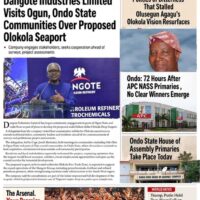
The renewed engagement by Dangote Industries Limited with host communities in Ogun State and adjoining coastal communities in Ondo State over the proposed Olokola Deep Seaport has once again reopened debate over what many describe as the “politics of hatred and rivalry” that derailed the original Olokola Free Trade Zone vision initiated under the late Olusegun Agagu.
The current consultations, which are taking place across coastal boundary communities where Ondo shares proximity with Ogun’s industrial corridor hosting the proposed refinery and seaport developments, highlight a new phase of engagement in which Ondo State’s participation is largely incidental and significantly reduced compared to the original blueprint.
Under the earlier Olokola Free Trade Zone arrangement, Ondo and Ogun States were conceived as joint owners of a massive integrated industrial corridor.
The plan was designed to give both states equal strategic stake in port development, refinery siting, petrochemical investments, export processing zones, and supporting infrastructure, positioning Ondo as a central industrial hub in Nigeria’s southern coastal economy.
However, political analysts and stakeholders argue that the vision suffered a major setback due to sustained political hostility, lack of continuity, and what some describe as deliberate resistance to Agagu’s development agenda by his successor ex governor Olusegun Mimiko.
These factors, they say, contributed to the gradual dismantling of the joint ownership framework that would have guaranteed Ondo a stronger economic position.
At the time, the Olokola corridor had attracted strong private sector interest, including early engagement from Dangote Industries, which reportedly explored locating major investments within the zone before the project structure was altered and investment direction shifted.
Today, however, the reality is markedly different. With the revival of deep seaport development now firmly anchored within Ogun State’s coastal industrial axis, Ondo State’s stake is considered minimal, with involvement largely limited to neighbouring boundary communities that may experience indirect spillover effects due to geographic proximity.
Observers note that Ondo’s current role is primarily tied to its coastal adjacency rather than strategic ownership or hosting rights, a significant departure from the original agreement that positioned the state as a co-equal beneficiary of the Olokola industrial corridor.
According to analysts, the abandonment of the joint development model has cost Ondo State a potentially transformative economic opportunity.
Had the original plan been sustained, the state could have become a leading industrial and logistics hub, with expanded revenue generation, large-scale employment opportunities, and deep integration into regional maritime trade.
For residents and policy watchers, the ongoing seaport consultations serve as both progress and reflection , progress for Ogun’s expanding coastal industrial ecosystem, and reflection for Ondo on what many believe was a missed opportunity shaped by political division and rivalry.
It will be recalled that the administration which succeeded Agagu, led by Olusegun Mimiko following a judicial pronouncement, is widely accused by critics of dismantling key components of the Olokola industrial and other agagu development legacy.
Among the most controversial claims is that the original plan to site the Dangote refinery in Ondo State was lost during that transition period, with stakeholders alleging that poorly managed negotiations and internal political interests contributed to the project’s relocation to Lagos, which many believe ultimately shifted the state’s industrial advantage away from Ondo.
As engagement continues, the central question remains whether Ondo State will secure meaningful economic gains from the emerging project, or continue to operate on the margins of a vision it once helped conceive but was never allowed to fully realize.