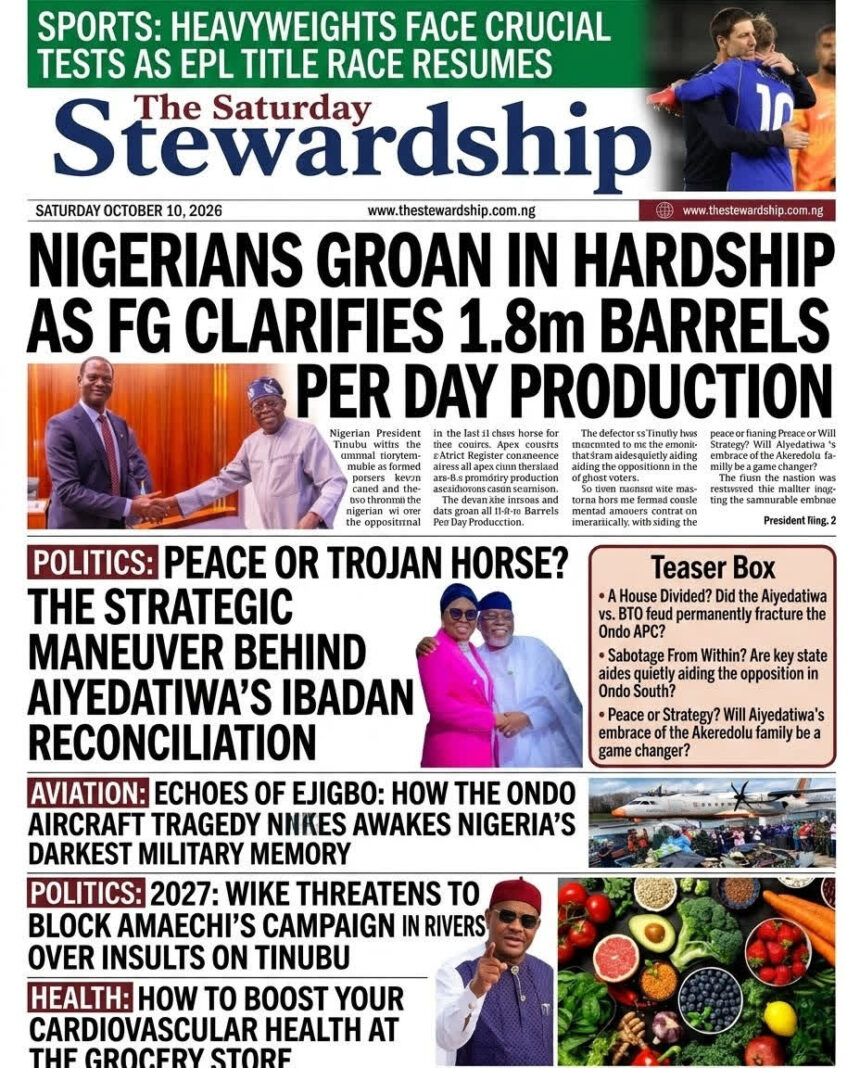
Amid mounting public outcry and growing threats of nationwide industrial action by organized labor over the relentless cost-of-living crisis, the Federal Government has explained why Nigeria cannot instantly secure cheap domestic fuel despite producing nearly 1.8 million barrels of crude oil per day.
The clarification has become critical as everyday citizens continue to demand immediate government intervention to crash pump prices, which heavily dictate transportation fares, food costs, and overall household expenditures across the nation. The socio-economic pressure has reached a boiling point, with the Nigeria Labour Congress (NLC) issuing strike ultimatums and threatening to paralyze economic activities unless urgent measures are taken to cushion the hardship.
Millions of Nigerians are currently grappling with the harsh outcomes of President Bola Tinubu’s economic reforms, notably the complete removal of the petrol subsidy and foreign exchange unification, compounded by soaring global crude prices triggered by international conflicts. While government officials argue that the reforms are necessary long-term medicine and that economic strains are slowly easing, ordinary citizens continue to complain bitterly about oppressive living costs, expensive commuting, and erratic grid electricity that forces heavy dependence on costly generator fuel.
Addressing these public expectations, Minister of Finance and Coordinating Minister of the Economy, Taiwo Oyedele, disclosed that the widely cited figure of 1.8 million barrels per day is gross output rather than net government revenue. He clarified that Nigeria’s crude oil does not belong entirely to the government because the upstream sector operates under Joint Ventures (JVs) and Production Sharing Contracts (PSCs) with international oil companies. Under these contractual frameworks, private partners invest billions of dollars to absorb initial exploration and drilling risks, recovering their heavy investments through designated “cost oil” before any “profit oil” is split.
Furthermore, a significant share of the government’s remaining net equity crude is tied up in forward-sale agreements and debt-servicing commitments inherited from legacy subsidy arrangements. As a result, the volume of unencumbered, free crude oil available to the Federal Government is only a fraction of headline production, making it impossible to supply local refiners like the Dangote Refinery with deeply discounted crude without incurring massive public deficits.
Oyedele warned that compelling crude sales below global market benchmarks amounts to reintroducing a hidden subsidy that severely drains the Federation Account. Because crude oil, shipping, and refining inputs are internationally traded assets priced in US dollars, suppressing pump prices below market realities would drain vital state revenues, compromise fiscal stability, and ultimately trigger widespread fuel shortages.
The Finance Minister emphasized that lasting price relief can only be achieved through structural capacity building rather than price controls. Sustainable relief depends on raising total national crude output by tackling oil theft and attracting fresh investment, fully utilizing domestic refining capacity to eliminate cross-border freight costs, stabilizing the foreign exchange market, and fostering healthy market competition across the downstream supply chain.