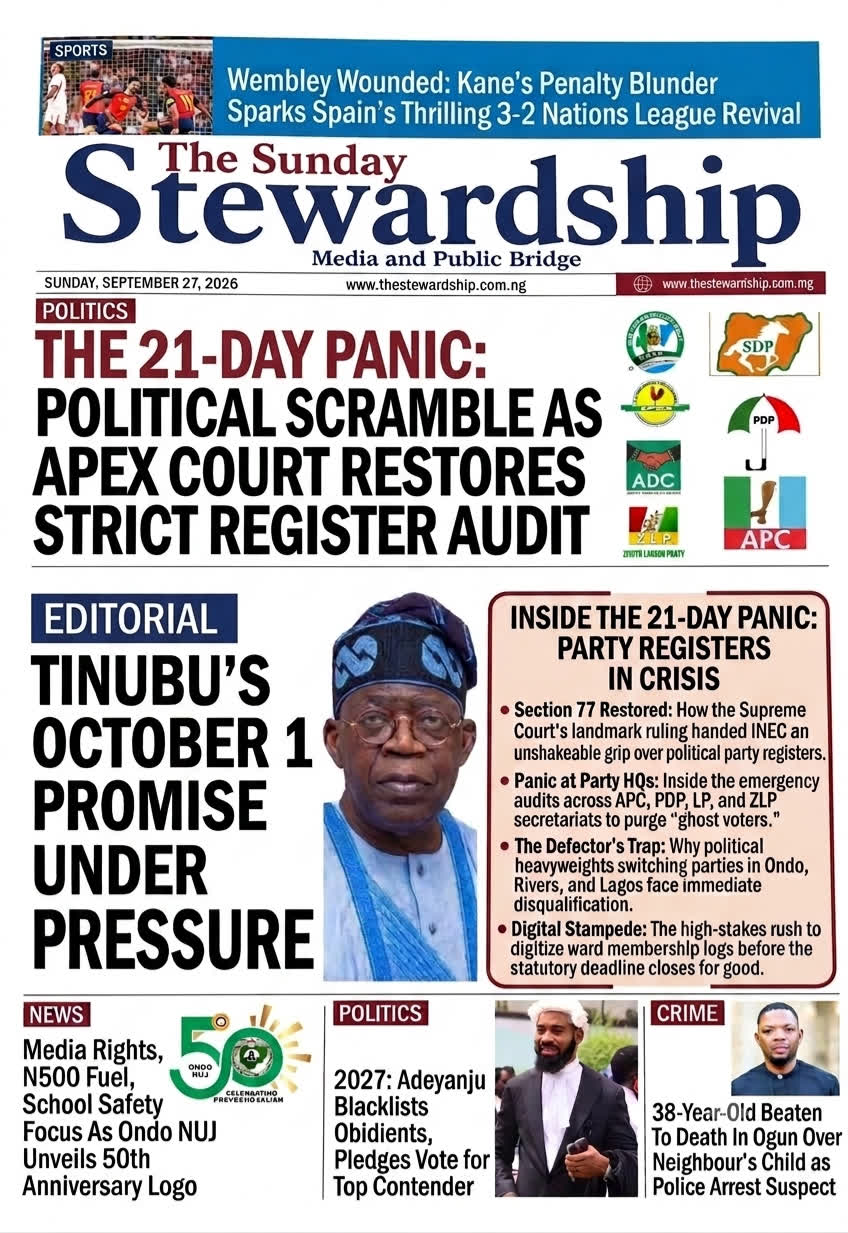
It is the deadline that hangs over the nation not with the fanfare of Independence Day parades, but with the quiet, suffocating pressure of a ticking clock. Across bus terminals, civil service complexes, and family kitchen tables, one date is repeatedly cited as the ultimate financial watershed: October 1.
Following an August 27 meeting with the 36 state governors, President Bola Ahmed Tinubu set October 1 as the definitive target date for Nigerians to begin experiencing measurable reductions in public transportation costs through the National Affordable CNG Transit Programme, coordinated alongside a committee chaired by Kwara State Governor AbdulRahman AbdulRazaq. Yet, as the calendar inches closer to the deadline, the promise is coming under immense fire, not from political opposition, but from the brutal mathematical realities on the ground.
While policy committees deliberate in Abuja, life for the average citizen has become an exercise in sheer financial endurance. Driven by global crude volatility, where Brent Crude has breached the $104 per barrel mark due to supply disruptions, domestic landing costs have skyrocketed. Retail Premium Motor Spirit (PMS) prices have surged across the country, ranging between ₦1,375 and ₦1,400 per litre in South-Western states, and reaching upwards of ₦1,430 to ₦1,500 per litre in Abuja and parts of the North. The resulting multiplier effect is catastrophic for a generator-reliant economy, driving up food logistics, local production, and commuting costs overnight.
For the average worker, this energy shock collides directly with the recently enacted ₦70,000 national minimum wage, completely dismantling its intended purpose as a safety net. At a retail pump price of ₦1,400 per litre, a worker devoting their entire monthly paycheck to fuel could purchase just 50 litres of petrol, barely enough to fill a single standard passenger tank once. For a civil servant facing daily round-trip commute fares of ₦2,000 to ₦2,500, transport alone swallows between ₦44,000 and ₦55,000 per month. This leaves a fragile remaining balance to cover food, shelter, utilities, medical care, and dependents for an entire month, forcing labor leaders to publicly acknowledge that the ₦70,000 baseline has been utterly neutralized by hyperinflation.
Mounting pressure from organized labor has brought this crisis to a boiling point. The Nigeria Labour Congress (NLC), backing civil service unions under the Joint National Public Service Negotiating Council, has issued a direct ultimatum giving the Federal Government until September 30 to act. Labor leadership, headed by NLC President Joe Ajaero, declared that the ₦70,000 wage has lost all purchasing power and demanded an immediate wage award for workers across federal, state, and local governments, alongside a reduction of petrol prices to ₦500 per litre to stabilize the economy. Rejecting temporary food palliatives as unsustainable interventions that fail to solve structural hardship, the NLC warned that failure to provide immediate relief will spark severe industrial tension.
Adding fuel to the fire is the insidious phenomenon of digital subscription fatigue and automated micro-debits. In an increasingly digital economy, workers face a secondary, invisible drain on their resources. Software licenses required for remote work, mobile data bundles consumed at high speeds, cloud storage renewals, and automated bank maintenance charges silently bleed remaining account balances overnight. A worker who budgets meticulously for basic groceries wakes up at 2:00 AM to an automated ₦4,500 debit notification, only to step out to the bus stop hours later and discover that daily transit fares have doubled again. They are left feeling caught in a vise—bled from the digital screen in their pocket and the tarmac under their feet.
In an effort to defend the October 1 mandate, the Presidency has pointed to a growing list of sub-national governments that have actively keyed into the Presidential CNG Initiative (Pi-CNG) and electric vehicle transition framework to prove that lower fares are achievable. Borno State is currently running CNG and electric buses charging between ₦50 and ₦100 on routes where commercial operators charge up to ₦600. Kaduna State’s fleet of 100 CNG buses has transported millions of passengers, while Kano and Edo states have deployed dozens of municipal CNG vehicles and converted over 1,000 commercial transit units. In Oyo State, Governor Seyi Makinde integrated CNG buses into the Pacesetter transport fleet, alongside extending the state’s ₦25,000 civil servant wage award and ₦10,000 pensioner allowance through December under the SAfER scheme. Other states, including Akwa Ibom, Delta, Kwara, Lagos, Enugu, Adamawa, and Abia, have taken delivery of CNG fleets or introduced subsidized transport systems to cushion the blow.
Despite these regional efforts, state-level wage top-ups and localized transit subsidies are being rapidly consumed by systemic inflation. When a worker’s weekly commute swallows their entire monthly wage allowance in a matter of days, emergency allowances cease to function as meaningful relief; they become temporary patches on a bursting dam.
Because of this structural gap, organized labor and millions of Nigerian workers are pinning their hopes on President Bola Tinubu’s traditional October 1 National Address. Workers are not looking for celebratory rhetoric; they are demanding a direct, unambiguous policy statement that outlines an immediate, tangible rollout of subsidized CNG corridors nationwide, clear directives on wage protections, and decisive government measures to stabilize energy costs and curb food logistics inflation.
As October 1 approaches, the Nigerian working class finds itself in a state of suspended animation. The commitment made in Abuja was explicit: cheaper domestic gas must translate directly into cheaper fares at the bus stop.
If President Tinubu’s October 1 address delivers a concrete rollout that slashes daily transit fares, addresses NLC’s demands, and restores purchasing power to the national workforce, it could mark the first tangible breath of economic relief for a struggling population. But if the statement offers only policy declarations while leaving citizens exposed to ₦1,400 petrol, inadequate minimum wages, and unrelenting micro-expenses, the trust between the governed and the government will face its most severe test yet. October 1 is no longer just a celebration of national history, it has become a live trial of economic survival.