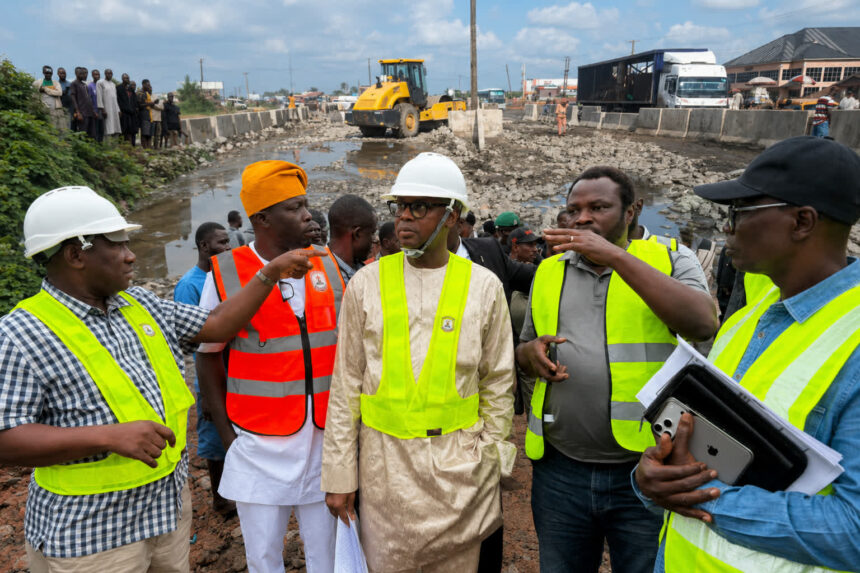
“You are learning how to do construction on our road. This is dangerous. I am very disappointed with the concessionaire, but I take full responsibility for the misdeed,” Minister of Works Senator David Umahi declared during his emergency inspection of the troubled Benin–Agbor–Asaba Expressway.
Addressing the Chief Executive Officer of the Benin-Asaba Expressway Concessions Company (BAECC), Samuel Daramola, the minister directly accused the firm of manipulating the procurement process to secure the project despite lacking the necessary technical competence, staff, and experience to execute a major highway build.
Umahi revealed that President Bola Tinubu had directed the Federal Ministry of Works to take whatever legal and executive measures are necessary to fix the road, including ordering a full redesign of the corridor into concrete pavement and threatening the arrest of any contractors who destroy existing public infrastructure without proper authorization.
The federal highway corridor was officially concessioned in 2025 by the Federal Government of Nigeria through the Federal Ministry of Works under a Public-Private Partnership (PPP) model. Because the route is a federal trunk road connecting multiple geopolitical zones, regulatory oversight and contract approval rested entirely with the Federal Government rather than the state administrations of Edo or Delta.
Under the 25-year concession agreement, BAECC was mandated to privately fund, reconstruct, and expand the 125-kilometer dual carriageway into a 10-lane superhighway, aiming to recoup its investment by erecting toll gates upon completion.
The critical situation on the highway stems from BAECC scraping off and dumping more than 30 kilometers of existing asphalt without first constructing proper side drainage systems or laying preliminary surfacing, directly ignoring explicit technical instructions from project consultants.
Severe seasonal torrential rains quickly combined with the stripped earth to wash away the foundation, creating expansive mud craters and rendering massive stretches of the road completely impassable.
The structural collapse of this critical arterial link connecting Western Nigeria to the South-East and South-South economic hubs triggered severe economic paralysis across the region. Intercity transport buses, heavy-duty haulage trucks, and fuel tankers were trapped in stagnant gridlock for three to four days along the Benin bypass and Agbor axis. The standstill halted supply chains, spoiled perishable agricultural goods, forced thousands of stranded passengers to walk long distances through knee-deep mud, and sparked local protests by transport unions and youth groups who barricaded remaining lanes to demand immediate government intervention.
Following the public outcry, Minister Umahi summoned the concessionaire, independent project engineers, legal teams, and representatives from the Edo and Delta State Governments to a summit at the Edo State Government House.
The meeting aims to formulate an immediate solution, coordinate emergency palliatives through alternative civil engineering firms like China Civil Engineering Construction Corporation (CCECC), and initiate a comprehensive legal review toward modifying or terminating the concession contract in the overriding public interest.
However as at this morning August 26th, 2026, The Stewardship News reliably gathered that, relief has finally come to thousands of stranded motorists along the Benin–Agbor–Asaba Expressway as the multi-day gridlock that brought vehicular movement to a complete standstill over the past four days began to ease.
Following emergency interventions deployed by the Federal Ministry of Works and alternative engineering firms like CCECC, ordered directly by President Bola Tinubu, heavy earth-moving equipment was brought in to grade failed sections and pack crushed stone into deep mud craters left by scraped asphalt. While trapped haulage trucks and interstate commercial buses are once again moving, transit along the corridor remains dangerously slow, with a typical 90-minute commute from Benin’s Second Junction to Asaba’s Summit Junction still stretching past five hours.
Commercial drivers and logistics operators report that while the gridlock is no longer a total blockade, navigating the corridor remains a costly ordeal. Fuel expenses for transit buses have more than doubled from roughly ₦20,000 up to ₦45,000 per trip due to prolonged stop-and-go idling in single-lane diversions, forcing commercial transporters to hike fares and inflating the cost of goods entering South-East and South-South markets. Meanwhile, government officials, National Assembly members, and legal delegates are meeting at the Edo State Government House to finalize emergency palliatives and initiate formal legal steps to review and terminate the concession arrangement with BAECC.
Meanwhile, traffic flow has finally returned to normal along the Lagos–Ibadan Expressway following hours of crippling gridlock that trapped motorists around the Sagamu Interchange axis. The severe bottleneck, which stretched across both corridors of the highway, was triggered by a multiple-vehicle crash involving heavy-duty trucks near the Sinoma outbound lane.
The situation deteriorated overnight into early morning as impatient drivers attempted to bypass the blockade by driving against traffic, effectively locking down vehicular movement from the Interchange toward Ibafo and Lagos.
Traffic management officials, including operatives from the Federal Road Safety Corps (FRSC), the Ogun State Traffic Compliance and Enforcement Corps (TRACE), and the Nigeria Police, successfully cleared the obstruction and restored order on the route. Authorities confirmed that all affected lanes have been reopened, bringing relief to stranded commuters and travelers navigating the commercial corridor.