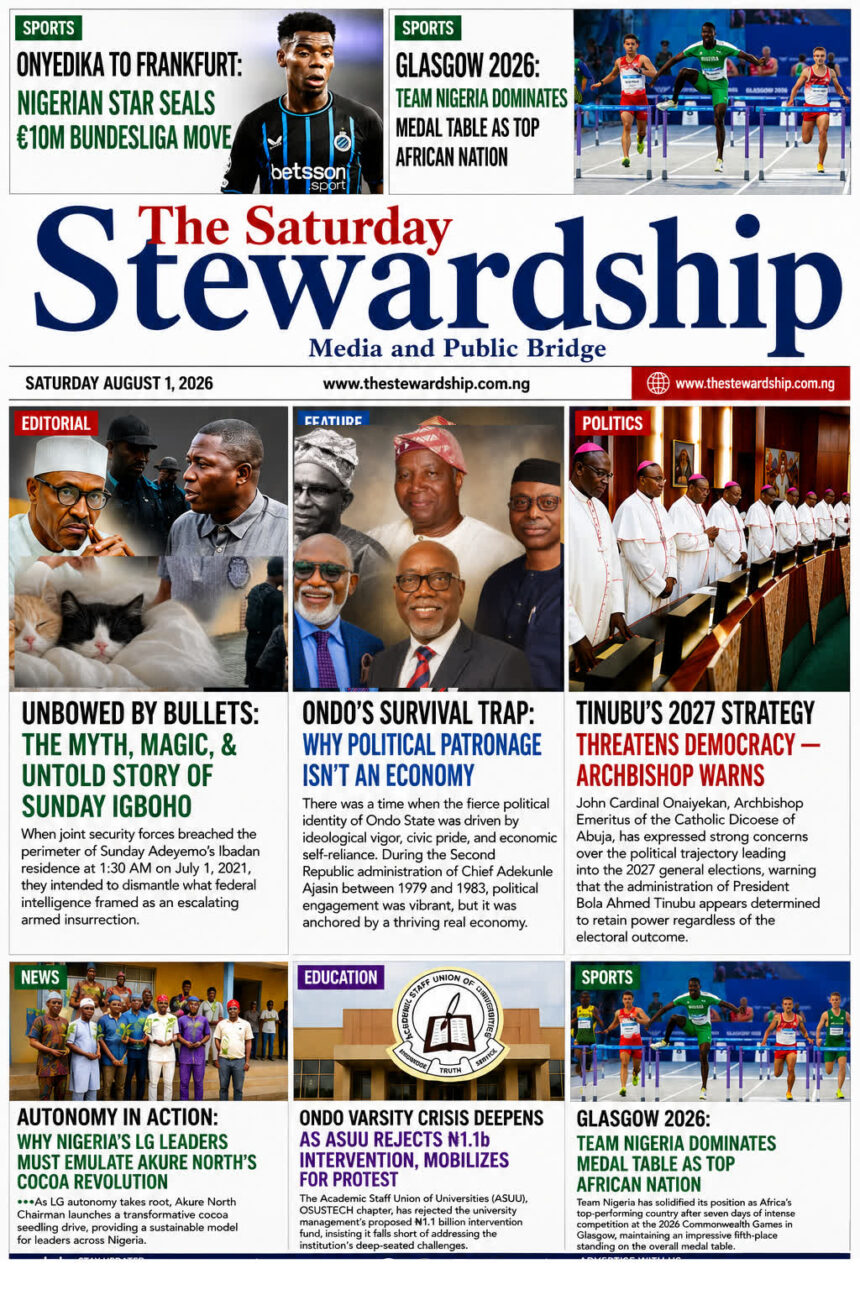
There was a time when the fierce political identity of Ondo State was driven by ideological vigor, civic pride, and economic self-reliance.
During the Second Republic administration of Chief Adekunle Ajasin between 1979 and 1983, political engagement was vibrant, but it was anchored by a thriving real economy.
Agriculture was honorable and lucrative, while industrial flagships like Ifon Ceramics, Oluwa Glass Company, Okitipupa Oil Palm Mill and host of others offered clear career pathways for school leavers.
The civil service was merely one option among many for ambitious youths seeking upward mobility.
Decades later, that proud trajectory has suffered a systematic decay, leaving what passes for political passion in the Sunshine State driven primarily by economic desperation.
Undoubtedly, the intense political instability currently engulfing Ondo State stems directly from widespread youth unemployment, industrial stagnation, and an under-developed private sector.
While Governor Lucky Aiyedatiwa will eventually complete his tenure, any future administration will face the exact same socio-political friction unless governance is fundamentally re-engineered around youth development and economic empowerment, no matter how many flyovers or infrastructure projects are built.
This aligns closely with the President’s persistent message to state governors: ensure the dividends of governance reach the grassroots, give the poor breathing room, and accelerate youth development. Central to this call is the urgent need to grant full autonomy to local governments so development can truly originate at the community level.
With thousands of graduates turned out annually from tertiary institutions and technical colleges into an economic vacuum, the state government has become the sole engine for basic financial survival.
Across successive civilian administrations, from Chief Adebayo Adefarati (1999–2003), Dr. Olusegun Agagu (2003–2009), and Dr. Olusegun Mimiko (2009–2017), to Arakunrin Oluwarotimi Akeredolu (2017–2023) and now Governor Lucky Aiyedatiwa, each government attempted to mitigate the employment crisis by absorbing fresh graduates into the state civil service.
While these recruitment drives offered temporary relief to thousands of households, reliance on public sector payrolls cannot solve structural unemployment.
A civil service cannot serve as an economy’s primary employer without eventually becoming overbloated, financially drained, and unproductive.
More critically, Ondo State has suffered from a chronic lack of policy continuity and executive capacity to execute bankable industrial projects.
The late Governor Olusegun Agagu did his utmost to lay a solid foundation for the industrialization of the state, designing master plans for the Olokola Free Trade Zone, deep seaport initiatives, and coastal infrastructure projects aimed at transforming Ondo into a major logistics and energy hub.
However, successive administrations failed to build upon this solid foundation with the required urgency, allowing mega-projects that could have permanently absorbed tens of thousands of skilled youths to stall.
Rather than leveraging national politics and federal alignment to secure strategic approvals for deep seaports, gas pipeline extensions, and rail connections for the overall advantage of the state, political capital is frequently squandered on internal party squabbles and regional infighting.
The macroeconomic indicators reflect this lost momentum. Ondo State generates an estimated Gross Domestic Product of ₦5.1 trillion ($8.5 billion), yet its GDP per capita remains modest at approximately $1,700 to $1,800, leaving individual purchasing power low while state wealth remains concentrated in raw resource extraction rather than value-added manufacturing.
Meanwhile, youth unemployment and underemployment have consistently hovered between 20 percent and 35 percent, forcing over 90 percent of the working-age population into informal, low-yield survival activities.
If this pattern continues unchecked, the economic implications will be devastating: deepening youth radicalization, an accelerating brain drain of top technical and IT talents to Lagos or abroad, and a dangerous spiral where state politics degenerates into a zero-sum battle over dwindling public allocations.
Faced with a stagnant private sector, local and state governance structures have turned into distribution centers for political crumbs.
The default strategy across recent cycles has been to appoint thousands of young people as Special Assistants or periodically reshuffle patronage rosters to stretch public funds across loyalty networks.
Youths who ought to be driving technology, commercial agriculture, and industrial processing spend their prime years trailing political patrons, shuffling between campaign headquarters, Abuja, and playing cards at political rendezvous points while waiting for personal handouts.
Even elders are not left behind in this unfortunate trend; many move fluidly between political factions, desperate for appointments to sustain basic living standards.
Once their tenure ends, the inability to sustain themselves outside public office drives them back into dirty, high-stakes political maneuvering.
Zero accountability and governance inertia are the inevitable outcomes, as few dare to demand transparency when personal survival depends entirely on the sitting administration.
The recent political friction between Governor Lucky Aiyedatiwa and Minister of Interior Olubunmi Tunji-Ojo exemplifies this ongoing distraction. Camps are formed not over competing visions for regional development, power infrastructure, or industrial revival, but over personal political positioning ahead of upcoming electoral cycles. Both young and old have been drawn into this unproductive cycle.
The high political temperature in Ondo State will not cool down simply because another election passes; it will persist until the state makes a conscious, deliberate turn away from survival politics toward structural transformation.
At this critical juncture, Ondo State requires critical forward thinkers equipped with verified capacity, absolute fiscal integrity, and an unyielding commitment to transparency and accountability.
The state urgently needs a selfless leader who truly belongs to all citizens, a unifying figure capable of managing and balancing the delicate political rotation among the three senatorial districts currently shaking the state’s stability.
Such leadership must arrive with a comprehensive, actionable vision that tackles security through tech-driven solutions and confronts economic stagnation head-on.
This leader must possess the global stature and economic credibility to command respect among Nigerian business leaders, international investment communities, and foreign diplomats, championing a bold entrepreneurial mindset akin to the transformative vision of Tony Elumelu and numerous tech founders.
At the very center of this imperative lies the Own Ondo 2028 Project, a strategic movement designed to redefine the collective future of all citizens, restore institutional integrity, and unlock sustainable prosperity across every community.
How long Ondo State permits political participation to serve as a substitute for actual productivity will determine whether the Sunshine State reclaims its legacy as an engine of intellect and enterprise or remains trapped in a perpetual state of political turbulence and human underdevelopment.