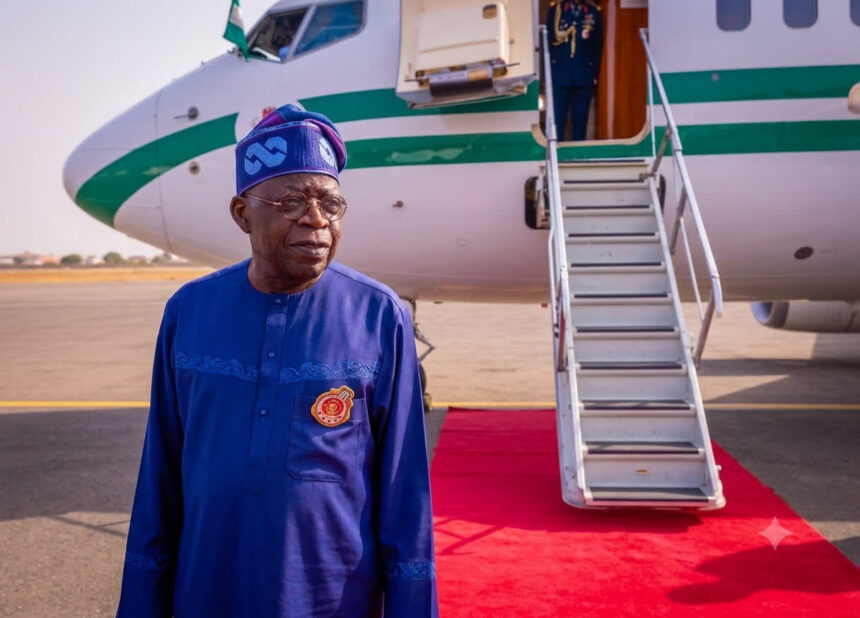
President Bola Ahmed Tinubu will return to Nigeria on Sunday after concluding an extended working vacation in Europe, according to sources familiar with his itinerary. The President is expected to land in Lagos first, where he will remain for up to a week to attend to state matters and local engagements before heading back to the Presidential Villa in Abuja.
The trip began on August 30 when President Tinubu departed Nigeria for London, United Kingdom, for a planned three-week working vacation as part of his annual leave. After spending a week in London, he traveled to Paris, France, for the second leg of his trip. Although the three-week period was originally slated to end earlier, the Presidency confirmed an extension of his stay abroad by several days to allow the President to complete key official engagements before returning home.
While in France, President Tinubu held several diplomatic and business meetings aimed at driving foreign direct investment into Nigeria. He met with French President Emmanuel Macron and held strategic discussions with major international business leaders, including French industrialist Vincent Bolloré, whose enterprise controls extensive interests across shipping, logistics, and media conglomerates like Canal+, MultiChoice, and Universal Music Group. The discussions centered on expanding private sector participation in Nigeria’s blue economy, improving deep sea port infrastructure, and boosting port operations across the country.
The administration maintained that President Tinubu actively directed state affairs remotely throughout his time abroad. Notably, he issued executive directives ordering an independent investigation into the tragic deaths of 37 illegal miners detained in Niger State.
Despite these activities, the extended European trip triggered intense political heat and sharp opposition backlash back home. Key political figures, including former Vice President Atiku Abubakar and opposition parties like the Peoples Democratic Party (PDP) and the African Democratic Congress (ADC), heavily criticized the President for failing to physically attend the 81st United Nations General Assembly (UNGA) in New York. Vice President Kashim Shettima was instead delegated to represent Nigeria and present the national address.
The controversy further deepened into constitutional debate surrounding Section 145 of the 1999 Constitution. Opposition leaders questioned whether executive powers ought to have been formally transferred via written declaration to the National Assembly once the trip surpassed 21 days, raising concerns about legal clarity while both the President and Vice President were out of the country simultaneously. The Presidency firmly dismissed these claims as irresponsible, stating that modern technology enables seamless presidential leadership from anywhere in the world and that Vice President Shettima carried the full mandate of the federal government in New York.