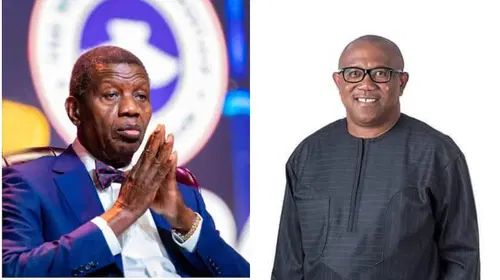
As the political maneuvering for the 2027 presidential election intensifies, the presidential candidate of the Nigeria Democratic Congress (NDC), Mr. Peter Obi, has strongly risen to the defence of the General Overseer of the Redeemed Christian Church of God (RCCG), Pastor Enoch Adeboye.
The move, which political analysts view as a calculated strategic outreach to the massive RCCG voting bloc, comes amidst a wave of criticisms targeted at the octogenarian cleric over the country’s lingering socio-economic challenges.
Ironically, the fierce online castigation of the revered cleric has been largely driven by members of the ‘Obidient’ movement, the fervent political wing and support base of Obi’s own political alignment.
In a comprehensive statement released via his official platform, the former Anambra State governor described Pastor Adeboye as one of the foremost fathers of faith in the nation who has spent decades preaching peace, love, and national reconciliation.
Obi strongly criticized the attacks, arguing that it is fundamentally unfair for young and able-bodied Nigerians to shift the burden of state governance and national transformation onto an 84-year-old religious leader, stating that the task of building a better Nigeria rests primarily on the shoulders of the younger generation.
The NDC flagbearer cautioned his followers and Nigerian youths against being manipulated by desperate politicians who exploit the nation’s fragile fault lines of ethnicity, religion, and identity when they cannot compete on superior ideas, performance, or character.
He warned against becoming instruments in the hands of those who secretly nurture division while publicly preaching unity, urging citizens to verify claims and resist emotional manipulation ahead of the upcoming political cycle.
While Obi’s camp insists the statement was a principled defence of an elder statesman, political observers note that the timing carries significant weight for the “Road to 2027.” By publically shielding Pastor Adeboye from the wrath of his own base, Obi is seen as making a sophisticated play to douse the tension and consolidate goodwill within the RCCG, one of the largest and most politically influential Christian denominations in Nigeria.
With the political landscape fracturing into new alignments following Obi’s transition to the NDC, securing the trust of major religious institutions will be pivotal, and analysts suggest that by championing the dignity of revered religious figures, Obi is positioning himself as a unifying, respectful leader capable of reigning in his supporters before the next general elections.