
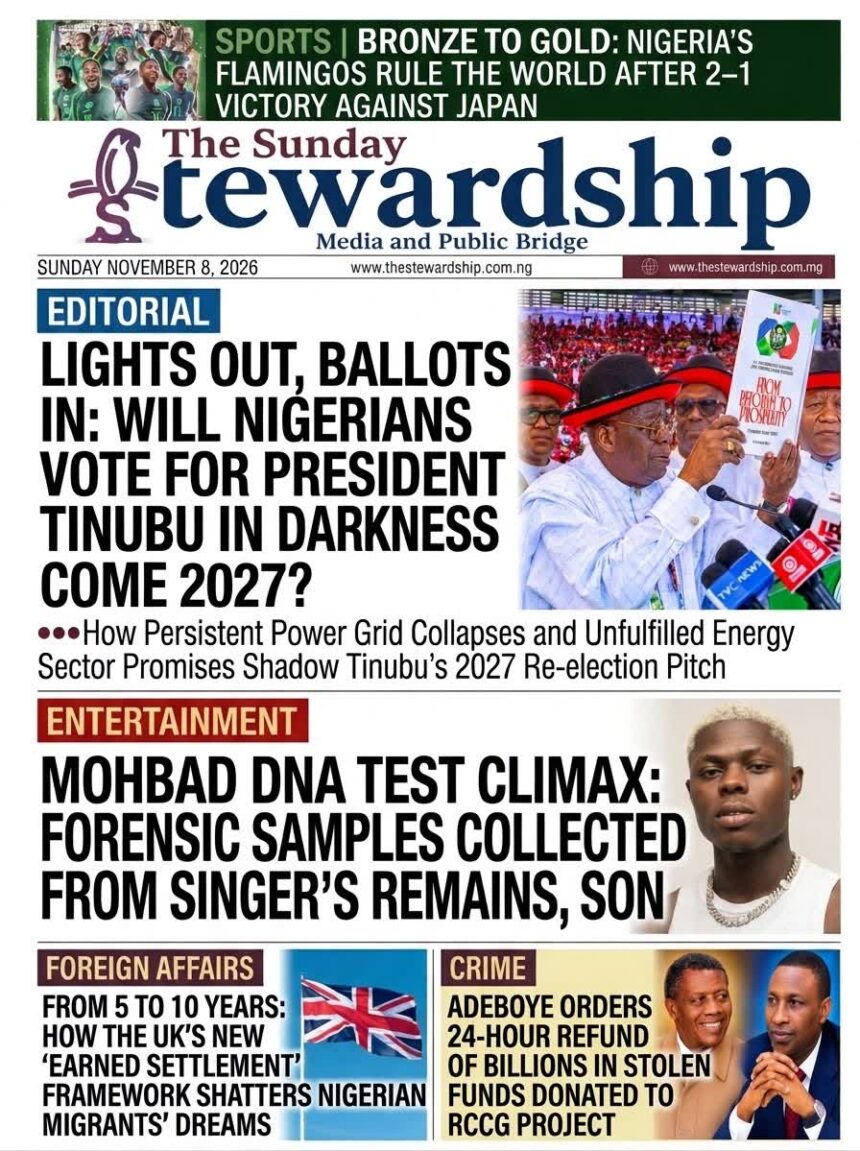
•••How Persistent Power Grid Collapses and Unfulfilled Energy Sector Promises Shadow Tinubu’s 2027 Re-election Pitch
With the 2027 general elections drawing near, the stark reality of Nigeria’s energy deficit has become one of the central political battles facing the nation. Years after President Bola Ahmed Tinubu assumed office pledging to systematically fix the power grid, millions of homes and businesses continue to grapple with persistent blackouts, high tariffs, and widespread off-grid reliance.
During the campaign trail and early into his tenure, President Tinubu pledged that under his Renewed Hope agenda, the power sector would undergo complete revitalization. Public discussions and campaign statements emphasized bold timelines to stabilize generation, transmission, and distribution within his first term. The political bargain was explicit: judge the administration by tangible improvements in basic infrastructure like power before seeking a mandate extension.
However, heading into the election cycle, grid generation has repeatedly slumped to around 3,600 MW for a population exceeding 200 million. The latest reminder of these systemic cracks came directly from the Nigerian Independent System Operator (NISO). In a public warning to consumers experiencing severe load shedding amid intense heat, NISO acknowledged that a double blow of acute gas shortages to thermal power plants and declining water levels at hydroelectric reservoirs had drastically throttled generation across the national grid. The system operator conceded that reduced power allocations to Distribution Companies (DisCos) left large swathes of the country enduring extensive daily blackouts.
On paper, the administration achieved major regulatory milestones early in its tenure. The signing of the Electricity Act 2023 operationalized constitutional amendments allowing states, private firms, and individuals to generate, transmit, and distribute electricity independently. States such as Lagos, Edo, Kaduna, Enugu, and Ekiti took advantage of the sub-national energy market framework by setting up State Electricity Regulatory Commissions (SERCs) to license independent power projects (IPPs) and regional mini-grids.
Public-private partnership (PPP) frameworks were also expanded to attract capital into embedded generation, metering programs, and transmission infrastructure. Yet, implementation has been uneven. While states like Lagos and Enugu have made progress attracting private mini-grid investors, macro-economic pressures, including foreign exchange volatility, high interest rates, and equipment import costs, have slowed down large-scale sub-national power generation across most of the federation.
The administration has poured trillions of Naira into targeted financial interventions and legacy debt settlements. Efforts were made to accelerate the Presidential Power Initiative (PPI) with Siemens to upgrade transformers, substations, and transmission line capacity. The Federal Executive Council approved multi-trillion naira payment frameworks, including a ₦3.3 trillion debt resolution plan, to clear legacy debts owed to Generation Companies (GenCos) and gas suppliers to unlock stranded capacity.
Furthermore, the Nigerian Electricity Regulatory Commission (NERC) introduced Service Band classifications to transition high-income customers and industrial clusters toward cost-reflective tariffs while attempting to phase out unsustainable state subsidies.
Despite these financial commitments, structural bottlenecks remain stubborn, leaving over 10,000 MW of installed generation capacity stranded due to fuel chain backlogs, unpaid gas supplier debts, transmission line collapses, and seasonal hydro fluctuations.
On the ground, small businesses and industrial manufacturers face steep operational costs, spending billions of Naira annually on alternative petrol and diesel power to maintain output. Household consumers face skyrocketing Band A bills alongside unpredictable outages and persistent estimated billing, suppressing manufacturing productivity and driving up consumer inflation nationwide.
Public reaction intensified following disclosures surrounding energy projects at the seat of power. The administration allocated funding to transition parts of the Presidential Villa (Aso Rock) to solar power systems to cut utility bills and ensure uninterrupted operational security. While energy experts framed the solar deployment as a practical move to adopt clean energy and cut state overheads, public outcry was swift. Critics and opposition candidates argued that disconnecting or insulating government buildings from the national grid sends a troubling signal to citizens who have no choice but to rely on erratic public power supply.
As political campaigns gear up for 2027, the power sector sits at the heart of the national debate. The ruling party maintains that multi-decade systemic collapse cannot be reversed overnight, pointing to legal decentralization, debt clearance schemes, and foundational grid infrastructure projects as long-term fixes that will yield results.
On the other hand, opposition coalitions and civil society groups argue that citizens should vote based on immediate living standards and economic hardship caused by high tariffs and recurring blackouts. Whether voters will accept structural reform assurances or express their discontent at the polls remains the critical question defining the upcoming election cycle.