
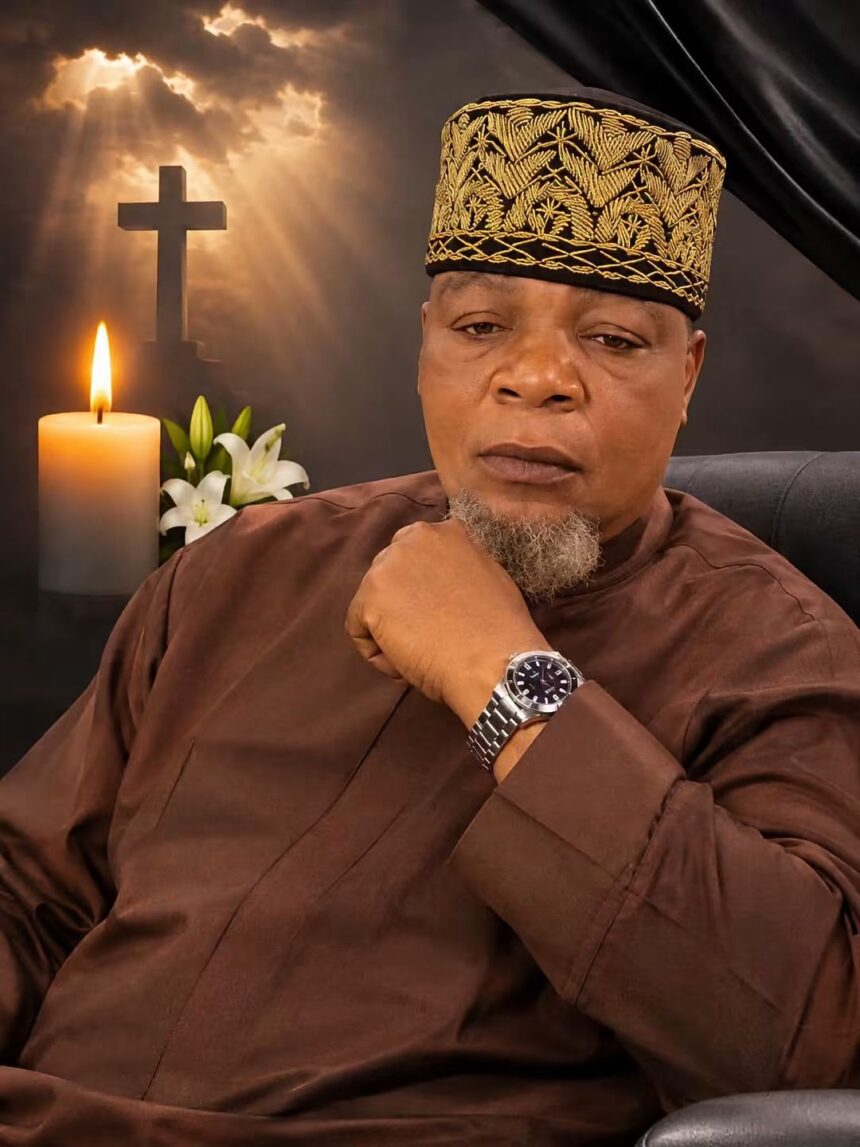
• Mixed reactions trail his legacy: Revered benefactor of Iro streets or feared enforcer of ‘omo onile’ and election wars?
Adeleye Fayehun widely known across Ondo State as Ade Basket, and later titled Oba Ade Basket, the Olu of Ifetedo, was a prominent, polarizing grassroots political figure, timber merchant, and traditional ruler in Akure, Ondo State, Nigeria.
His public life spanned more than two decades of street-level politics, community leadership, and controversy, stretching from the turbulent 2003 general elections until his death at age 60 on November 11, 2026. Because much of Ondo State’s grassroots political history is preserved through local newspaper archives, oral folklore, and social media rather than formal court transcripts, the full portrait of Ade Basket sits squarely at the intersection of street enforcement, political patronage, philanthropy, and traditional authority.
Quick Search

Like many grassroots political mobilizers in southwestern Nigeria during the late 1990s and early 2000s, Fayehun’s early influence was forged through street credibility, physical presence, and neighborhood mobilization rather than formal academic credentials. Growing up in Akure, his moniker became synonymous with street-level influence.
His political “radicalization” mirrored the early years of Nigeria’s Fourth Republic after 1999, an era in which local youth leaders, motor park officials, and neighborhood strongmen became indispensable foot soldiers for political parties competing to control polling units and wards. Later in life, seeking to broaden his formal education beyond his rugged street background, he pursued higher studies at Adekunle Ajasin University, Akungba-Akoko (AAUA).
From the contentious 2003 elections onward, Ade Basket remained a recurring fixture in Ondo State’s political machinery, navigating shifting party alliances while maintaining a firm stronghold in Akure South. Following Governor Olusegun Agagu’s 2003 victory, grassroots enforcers in Akure played major roles in consolidating People’s Democratic Party (PDP) dominance against the Alliance for Democracy (AD). Later, through the fierce political battle between Agagu and Dr. Olusegun Mimiko, culminating in Mimiko’s 2009 judicial victory and 2012 re-election, Ade Basket operated within Akure’s shifting mobilization networks, aligning closely with Mimiko and key power brokers in the state capital.
Under Governor Oluwarotimi Akeredolu (SAN) and subsequently Governor Lucky Aiyedatiwa between 2017 and 2026, Fayehun aligned closely with the ruling All Progressives Congress (APC), transitioning by the final years of his life from a feared street enforcer into a recognized party stakeholder and elder in Akure.
Throughout the 2000s and 2010s, however, Ade Basket’s name frequently surfaced in local political discourse surrounding election-day intimidation, violent clashes between rival party factions, and turf wars in the state capital. To political opponents, he represented the muscle deployed to sway local wards. Within Akure, the Iro community, alongside the adjoining axis around Oba Adesida Road, Old Garage, and Isolo, served as the primary base for Fayehun and his loyalists, commonly referred to as “his boys.” His network functioned as an informal authority in the neighborhood, settling street disputes, controlling local territory, and mobilizing crowds at short notice.
During periods of heightened political tension, Fayehun and his associates repeatedly faced police invitations, arrests, and detentions. Notably, between 2007 and 2008, security agents whisked him away to Abuja over allegations of destroying Coca-Cola products. He spent several months in detention in the federal capital before eventually securing his release through the alledge influence and intervention of Dr. Olusegun Mimiko, who was later sworn in as governor in 2009 after retrieving his governorship mandate from Olusegun Agagu through a landmark court judgment.
As urbanization and real estate expansion accelerated across Akure, Fayehun’s group was also widely associated with the notorious omo onile menace, acting as aggressive informal land tax collectors and perimeter enforcers who demanded levies from property developers, landlords, and builders at various stages of construction. Alongside these urban land tussles, his network faced allegations of forcible rural encroachment. In one painful oral account from the Ilado community of Akure, an elderly resident, who preferred to speak in the dark out of lingering fear, recounted how Ade Basket and his boys forcefully encroached upon local farmlands to fell timber, subsequently driving heavy lorries directly across the farms during log evacuation and destroying farmers’ crops and plants in the process.
In Ondo State, one of Nigeria’s richest forestry hubs, access to timber concessions, sawmills, and forestry permits has historically served as a primary vehicle for political patronage. Over time, Ade Basket leveraged his political goodwill to establish himself in the timber and logging industry. Operating timber concessions enabled him to build substantial wealth, employ dozens of youths from Akure, and transition from relying solely on political handouts to becoming an independent financier and employer within his community, even as property owners and agrarian communities like Ilado bore the brunt of aggressive levies and logging operations.
Despite his rugged street reputation, Fayehun became deeply integrated into Akure’s traditional institution. He was elevated into traditional leadership as Oba Ade Basket, the Olu of Ifetedo, formally cementing his status within Akure’s traditional hierarchy and community leadership. He also became a prominent participant and financier during major Akure traditional festivals, most notably the Ulefunta and Ogun festivals, where he regularly led cultural processions and maintained order among youth groups.
In his later years, particularly from 2020 onward, Fayehun granted several candid interviews to local Yoruba radio stations, Facebook Live bloggers, and Akure-based YouTube channels. He consistently rejected the label of a “common thug,” describing himself instead as a freedom fighter, political strategist, and defender of his people who stood up when political oppressors sought to intimidate Akure indigenes.
At the same time, in vernacular interviews, he acknowledged the turbulence of his youth, warning that young men who engage in political violence are routinely abandoned by politicians once power is secured. He urged Akure youths to pursue legitimate trades and formal education, pointing to his own timber business and academic pursuit at Adekunle Ajasin University, rather than risking their lives for politicians.
Within the Iro axis and greater Akure, Ade Basket was simultaneously viewed by many residents as an accessible benefactor. Locals frequently credited him with paying school fees, settling hospital bills, assisting market women with micro-grants, and acting as an informal security buffer against street crime and external gangs.
He was also a passionate supporter of grassroots football in Akure, sponsoring local novelty matches and youth tournaments while supporting local players affiliated with Sunshine Stars FC and neighborhood academies. Away from the streets, he was a family man survived by wives and children, many of whom he deliberately shielded from street politics, prioritizing their formal education and private careers.
In October 2026, Ade Basket suffered a devastating personal loss with the passing of his wife, Mrs. Atinuke Fayehun, who was buried in Akure in late October in a ceremony attended by family, associates, and local dignitaries. Following her death, an emotional video of Fayehun circulated widely across Nigerian social media platforms.
Visibly broken and weeping, the typically tough-talking strongman spoke on the circumstances surrounding her passing, expressing deep anguish and invoking prayers and curses for vengeance, wishing that whoever was responsible for her death would also die swiftly.
Prior to late 2026, Ade Basket maintained an active public and social media presence with no widely publicized chronic medical conditions. However, shortly after burying his wife in late October 2026, his health deteriorated rapidly. According to The Hope newspaper and close family sources, he was hospitalized for several weeks for an undisclosed ailment.
After battling the illness, Adeleye Fayehun died at age 60 on the night of Tuesday, November 10, into the early hours of Wednesday, November 11, 2026, at the Ondo Trauma and Surgical Centre in Ondo, barely two to three weeks after his wife’s burial.
The back-to-back tragedies in the Fayehun family sparked widespread shock across Ondo State, alongside sharply mixed public reactions regarding his life and legacy. While a cross-section of the public, particularly in Akure’s Iro axis and traditional quarters, mourned him as a “general,” a generous benefactor, and a protector of the masses who contributed meaningfully to grassroots community development, another cross-section maintained that his actions inflicted huge, lasting damages on individuals, livelihoods, and the political climate of the state.
Critics, property developers subjected to omo onile extortion, agrarian communities affected by logging encroachments, and victims of past political violence noted that fear of reprisal during his lifetime, combined with the cultural norm against speaking ill of the dead, kept many from openly recounting the intimidation, property destruction, and electoral violence associated with his peak years.
From a feared street enforcer in 2003 and Abuja detainee in 2007–2008 to a university student, wealthy timber merchant, titled traditional ruler, and deeply polarizing community figure at his death in 2026, Ade Basket’s life remains a defining case study in the complex intersection of grassroots politics, informal security, and traditional authority in southwestern Nigeria.