

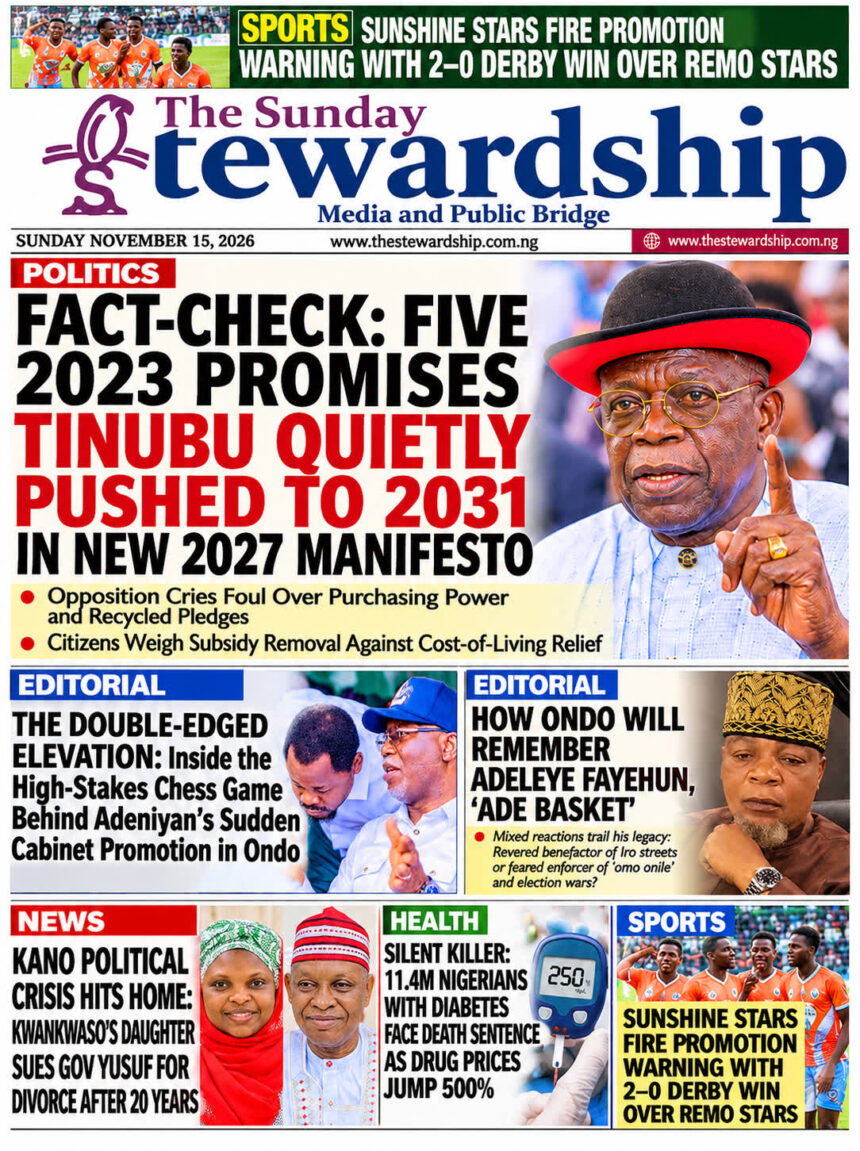
•Opposition Cries Foul Over Purchasing Power and Recycled Pledges
•Citizens Weigh Subsidy Removal Against Cost-of-Living Relief
Following the All Progressives Congress (APC) unveiling of President Bola Ahmed Tinubu’s 2027–2031 re-election policy document, titled “From Reforms to Prosperity,” a direct comparison between the 109-page blueprint and his original 2023 Renewed Hope manifesto reveals that several major policy targets originally slated for his first term have been extended to 2030 or 2031.

While APC leaders and cabinet members defend the new document as a natural continuation of difficult economic reforms already undertaken, most notably the removal of petrol subsidies and foreign exchange unification, an audit of the two texts shows that key pledges across health insurance, electricity generation, affordable housing, and social welfare have been carried forward with revised timelines.
In the healthcare sector, the 2023 manifesto promised to achieve 40 per cent health insurance coverage within two years of taking office, whereas the 2027–2031 policy document repeats the same 40 per cent coverage target alongside 90 per cent functional primary healthcare centres, extending the deadline by six years to 2031. Similarly, in the power sector, where the 2023 document pledged reliable electricity generation and distribution to end persistent outages, the new manifesto establishes a fresh benchmark of scaling available electricity generation toward 10,000 megawatts by 2031.
On affordable housing, the original 2023 plan to review the Land Use Act and launch a low-income social housing scheme has been carried over and attached to a specific quota of building 200 homes in each of Nigeria’s 774 Local Government Areas, totaling 154,800 units toward a broader 200,000-unit goal. In governance, the 2023 commitment to enact legislation guaranteeing women at least 35 per cent of all governmental positions remains unfulfilled and is repeated in the new blueprint.
Meanwhile, the 2023 pledge to provide conditional and unconditional cash transfers to extremely poor and elderly citizens has been expanded into a target to verify 20 million people on the National Social Register by 2030 and execute the $1 billion HOPE-SP programme.
Defending the administration’s record during the unveiling in Abuja, APC campaign officials and ministers argued that the first term was deliberately focused on stabilizing the macroeconomy, with the next four years designed to transfer those gains to ordinary households. Minister of Solid Minerals Development and APC Presidential Campaign Council spokesperson Dele Alake urged Nigerians to back continuity, stating, “You don’t change a winning horse. The APC government is a winning horse. You cannot afford to change it.”
Minister of Budget and Economic Planning Atiku Bagudu added that Nigeria had recorded 13 consecutive quarters of economic growth alongside declining inflation, noting that the administration’s objective is to ensure economic growth translates into improved living standards. Information Minister Mohammed Idris also pointed to the Nigerian Education Loan Fund (NELFUND), stating that roughly 1.6 million students had already benefited from the scheme.
During separate campaign engagements in Jigawa, President Tinubu simultaneously ruled out any return of petrol subsidies, arguing that subsidy removal freed up funds for road repairs, security, and upcoming interest-free loans for small-scale farmers.
However, the unveiling of the manifesto has ignited fierce political pushback from opposition parties and sparked widespread debate among citizens over the gap between macroeconomic figures and household purchasing power. Leading the opposition critique, the African Democratic Congress (ADC) dismissed the policy document as a political gimmick that recycles unfulfilled 2023 pledges, with its National Publicity Secretary, Bolaji Abdullahi, insisting that the 2027 election will serve as a referendum on the administration’s performance rather than a fresh set of assurances. The ADC noted that while the ruling party described 4,500 megawatts of electricity as a crisis in 2023, the new manifesto acknowledges average generation of just 4,022 megawatts, adding that inflation and currency depreciation have eroded more than a quarter of the purchasing power of the ₦70,000 national minimum wage.
Adding to the criticism, the campaign organisation of Oyo State Governor and Allied Peoples Movement (APM) presidential candidate Seyi Makinde accused the ruling party of appropriating policy ideas from his RESET Nigeria development agenda, claiming that while the administration adopted similar language on economic restructuring, it lacked the execution capacity to deliver relief to ordinary citizens.
Among everyday Nigerians and across social media platforms, public reaction has largely centered on President Tinubu’s emphatic declaration that petrol subsidies will never return. While some commentators welcomed the administration’s transparency and pointed to ongoing federal road construction and NELFUND student loan disbursements as early dividends, many market traders, commuters, and civil servants questioned how low-income families will cope in the immediate term before proposed interventions, such as interest-free farmer loans and the $1 billion HOPE-SP cash transfer programme, materialize.
Economists and policy watchers further note that given prevailing economic realities, the administration faces significant execution hurdles in meeting its new targets of less than 8 per cent inflation, 6 per cent annual economic growth, and a $1 trillion economy by 2031, warning that the pledges will only resonate with voters if they produce measurable relief in living standards.
To bridge that gap, the 2027 manifesto commits the administration to specific accountability measures within the first 100 days of a second term, including publishing performance baselines for ministries, introducing a quarterly cost-of-living basket, opening secured farm-to-market corridors, and conducting an independent audit of unfinished or underused federal assets.




 unveiling of President Bola Ahmed Tinubu’s 2027–2031 re-election policy document, titled)