


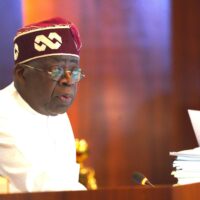
President Bola Ahmed Tinubu has formally requested the Senate’s approval for a supplementary external borrowing plan of $20.52 billion and €1.05 billion (€1.045 billion) under the Federal Government’s 2026–2027 borrowing framework. The official executive communication, read by Senate President Godswill Akpabio during plenary, revealed that the multi-year loan package is targeted at bridging critical capital deficits across the national economy.
Alongside the loan request, President Tinubu transmitted the Transfer of Convicted Offenders (Enactment and Enforcement) Amendment Bill, 2026, to the upper legislative chamber for expeditious consideration. The proposed legislation seeks to amend the existing legal framework (Cap. T16, LFN 2004) to allow Nigeria to conclude prisoner transfer agreements with nations outside the Commonwealth. Under the amendment, the President can extend the act to non-Commonwealth partner nations via an order published in the Federal Gazette, strengthening cross-border judicial cooperation and offering relief to overcrowded custodial facilities through repatriation frameworks.
The high value borrowing plan is structurally tied to the Federal Government’s Medium-Term Debt Management Strategy (MTDS) and the Medium-Term Expenditure Framework (MTEF). Government officials emphasize that large-scale physical infrastructure, agriculture, and power programs operate on multi-year execution cycles, necessitating long-term rolling finance approvals. By sourcing low-cost, long-tenor external loans from development finance partners, such as the World Bank, African Development Bank, and Islamic Development Bank, the administration aims to prevent domestic credit market crowding and lower sovereign debt-servicing burdens.
Funds raised under the 2026–2027 external borrowing plan are earmarked for strategic capital investments across several crucial growth sectors:
In transportation and urban mobility, the financing will fund major rail and road corridors. Ongoing projects expected to draw from these funds include the Lagos-Kano and Kano-Maradi standard gauge rail developments, alongside interstate highway expansion networks and regional trade bypasses.
In power and energy, the funding will be directed toward power grid rehabilitation, national transmission line expansions, and off-grid renewable energy projects meant to improve rural electricity access and industrial energy reliability.
In agriculture and food security, investment will go into commercial irrigation schemes, specialized agro-processing zones, and storage hubs to boost domestic food production and tackle food inflation.
In human capital and social infrastructure, allocations will prioritize the expansion of primary and tertiary healthcare facilities, modernizing vocational institutions and federal universities to improve youth employable skills, and upgrading municipal water supply and sanitation projects nationwide.
Senate President Godswill Akpabio has committed the external borrowing request to the Senate Committee on Local and Foreign Debts. The Transfer of Convicted Offenders Amendment Bill has been referred to the Senate Committee on Rules and Business for further legislative processing before its second reading.





 under the Federal Government’s)