President Bola Ahmed Tinubu has defended the importance of building enduring political structures from the grassroots, declaring that democracy cannot survive on “noise, speculation, or borrowed platforms,” in what many political observers see as a response to the recent wave of defections and political realignments ahead of the 2027 elections.
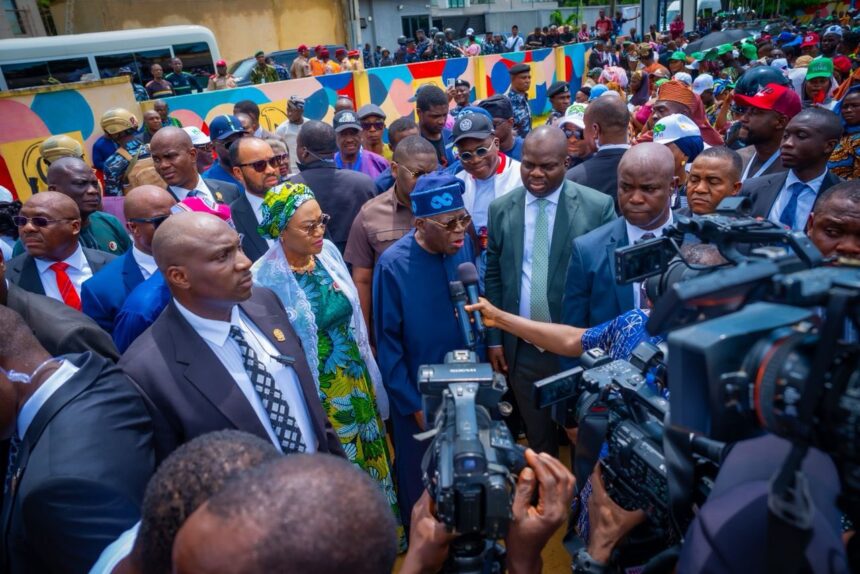
The President made the remarks on Saturday after participating in the All Progressives Congress (APC) presidential direct primary at his polling unit in Ikoyi, Lagos, alongside the First Lady, Senator Oluremi Tinubu.
Although Tinubu did not directly mention any opposition figure, his comments have been widely linked to the recent political movements involving former Vice President Atiku Abubakar and former Labour Party presidential candidate Peter Obi, both of whom have been associated with shifting political alliances in search of ready made and viable presidential platforms.
Political analysts argue that Tinubu’s statement was less about attacking the opposition and more about emphasizing consistency, party loyalty, and long-term political institution-building.
Atiku Abubakar, who recently aligned with the African Democratic Congress (ADC) after years within the Peoples Democratic Party (PDP), has frequently changed political platforms throughout his political career.
Similarly, Peter Obi, who began his political journey in the All Progressives Grand Alliance (APGA), later moved to the PDP, contested under the Labour Party, and recently joined Atiku in the ADC been linked with emerging coalition movements and finally to become the presidential flag bearer of NDC ahead of the 2027 general elections.
Observers say the President’s remarks reflect his belief that sustainable democracy is rooted in strong political structures built over time rather than temporary alliances formed around election cycles.
According to Tinubu, “Democracy is not sustained by noise, speculation, or borrowed platforms. It is sustained by citizens who show up, party members who believe, institutions that endure, the grassroots, and a political family rooted in the people.”
The President further described the APC as a stable and deeply rooted political organization with nationwide structures capable of sustaining governance and national development.
“The APC remains focused, organised and deeply grounded across Nigeria. Others may gather around grievance. We gather around structure, service, and the work of nation-building,” he stated.
Supporters of the President argue that Tinubu’s political journey has largely been defined by consistency and long term party building. Since the formation of the APC in 2013, Tinubu has remained one of the party’s central figures, playing a major role in strengthening its national structure and electoral success.
His allies maintain that unlike many opposition politicians who frequently move between parties in search of electoral opportunities, Tinubu has invested years in building political networks, grassroots support systems, and institutional loyalty within the APC.
The statement has continued to generate reactions across political circles, with APC supporters praising the President’s emphasis on structure and continuity, while opposition loyalists insist that political coalitions and alliances remain legitimate democratic strategies in a multi-party system.
As preparations for the 2027 elections gradually intensify, Tinubu’s remarks are expected to further deepen the ongoing political debate over party loyalty, ideological consistency, and the future direction of opposition politics in Nigeria.