By Editor
Words travel. Along the way, they change meaning, shape belief systems, and sometimes alter entire cultures. Few words demonstrate this power more than Satan and its African cousin, Satani.
Across Africa today, “Satani” is casually used to describe evil, demons, or anything spiritually dangerous. But where did this word come from? And more importantly, what did African societies believe before it arrived?
This first episode examines how the name “Satan” evolved across religions, how “Satani” entered African languages, and how indigenous spiritual concepts were redefined through foreign lenses.
Satan Before the Devil
In early Hebrew tradition, śāṭān was not a proper name. It simply meant an adversary, accuser, or opponent. In the Old Testament, the word usually appears as ha-satan , “the adversary”, a role, not a personality.
In books like Job and Zechariah, ha-satan functions as a kind of heavenly prosecutor, operating under God’s authority. There is no cosmic rebellion, no fallen angel, no embodiment of absolute evil. That idea comes much later.
Only in 1 Chronicles 21:1 does the word appear without the definite article , a small linguistic shift that later religions expanded into a full personality.
How Satan Became Absolute Evil
During the Second Temple period, Jewish thought absorbed ideas from Persian dualism, especially the notion of opposing forces of good and evil. By the time Christianity emerged, Satan had transformed into a personalized enemy of God , a fallen angel, tempter, and ruler of darkness.
The New Testament solidified this image, even retroactively identifying the serpent in Genesis as Satan , a connection not made in the original Hebrew text.
Islam followed a related but distinct path. In the Qur’an, Shayṭān refers to tempters and adversaries, while Iblis is the specific being who refused to bow to Adam. Crucially, Iblis is a jinn, not an angel, and evil is framed as disobedience and arrogance rather than inherited sin.
From Satan to Satani
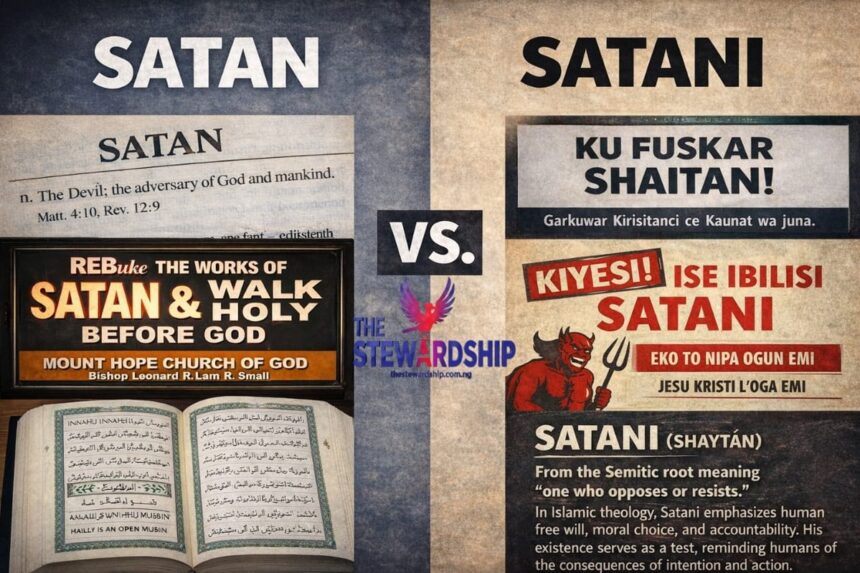
Satani is not an indigenous African word.
It entered African languages through Arabic (Shayṭān) via Islam and later through European missionary Bible translations. Variants appear across the continent , Shetani in Swahili, Satani in Hausa and Yoruba, and similar forms elsewhere.
Over time, the word absorbed Christian meanings of cosmic evil and was applied broadly to spirits, rituals, and beliefs that missionaries could not easily categorize.
This is where the distortion began.
The Case of Èṣù
In Yoruba cosmology, Èṣù is an òrìṣà of communication, balance, justice, and consequence. He is neither evil nor benevolent in the Christian sense. He enforces divine order and ensures that actions have results.
Yet early missionaries, struggling to translate the Christian “Devil,” equated Èṣù with Satan, a decision that reshaped perception permanently.
Oríkì such as “Èṣù má ṣe mí, ọmọ elòmíràn ni kó ṣe” or vivid metaphors describing his fearsome nature were read literally, rather than as hyperbole and symbolic language, which Yoruba tradition uses richly.
What was once moral complexity became “demon worship.”
Africa Without a Devil
Traditional African religions largely lack a singular, eternal enemy opposing the Supreme Being. There is no African equivalent of a fallen angel leading a cosmic rebellion against Olódùmarè, Chukwu, or Nyame.
Evil is understood differently: as imbalance, broken taboos, human choice, ancestral consequences, or social disharmony. Morality is communal, not dualistic.
The introduction of Satani quietly imported a foreign worldview, reframing African spirituality as something that needed saving.
Why Names Matter
Names carry assumptions. When Africans adopted the word Satani, they also adopted a moral framework that divided the world into absolute good and absolute evil, often at the expense of indigenous nuance.
This legacy still shapes modern religious discourse, where traditional practices are casually labeled “Satanic” without historical understanding.
Going forward, in the next episode, this series will explore how translation became a tool of power, and how African societies negotiated, resisted, and sometimes reclaimed their spiritual identity.