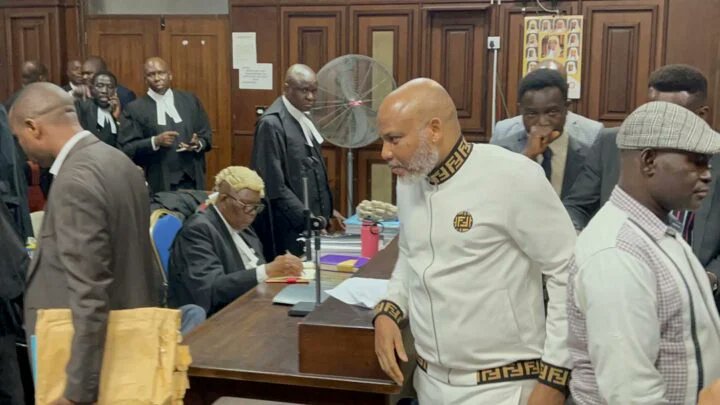
There was heightened drama at the Federal High Court in Abuja on Thursday as Justice James Omotosho ordered the removal of the detained leader of the Indigenous People of Biafra (IPOB), Nnamdi Kanu, after he repeatedly disrupted proceedings during the delivery of judgment in his terrorism trial.
Trouble began when Kanu insisted that the court must discontinue the judgment, claiming he had already filed fresh processes at the Court of Appeal. He argued that his pending appeal should automatically halt the day’s proceedings.
The court, however, dismissed his motion for leave to file a written address, ruling that the time allotted for such filings had long expired.
Justice Omotosho held that the application was another attempt to delay the trial, noting that Kanu had previously been given multiple opportunities to defend himself but declined, insisting the court lacked jurisdiction.
Prosecution counsel also urged the court to disregard all pending motions from the defendant, arguing that they “lack merit and do not warrant consideration.” This submission further intensified the already heated atmosphere.
Kanu, visibly agitated, continued to insist on his rights and challenged the judge openly. As his interruptions persisted, Justice Omotosho restated that the day’s session was strictly for the delivery of judgment and would not be derailed by any further objections.
The courtroom atmosphere quickly deteriorated as Kanu’s reactions grew more intense. During the live television broadcast, he was seen raising his voice at the judge, prompting Justice Omotosho to order the Department of State Services (DSS) to remove him from the courtroom.
When DSS operatives approached to enforce the order, Kanu shouted, “Don’t touch me,” escalating the tension. The disruption forced the judge to call a five-minute recess to restore calm.
During the break, DSS officials were seen speaking with Kanu before escorting him out of the courtroom in a more orderly manner. Proceedings later resumed under tightened security as the court continued with the judgment.
Kanu is facing charges bordering on terrorism, which he has consistently described as unlawful. He maintains that the Federal High Court lacks jurisdiction to try him and insists the Terrorism (Prevention) Act under which he is charged does not apply to his case.
The judgment, regarded as a pivotal moment in the long-running legal battle between the IPOB leader and the Federal Government, is currently being delivered at the time of filing this report.