Ondo State Governor, Lucky Orimisan Aiyedatiwa, has reaffirmed his administration’s determination to reposition the state’s education sector through digital innovation, inclusive policies, and professional teacher development.
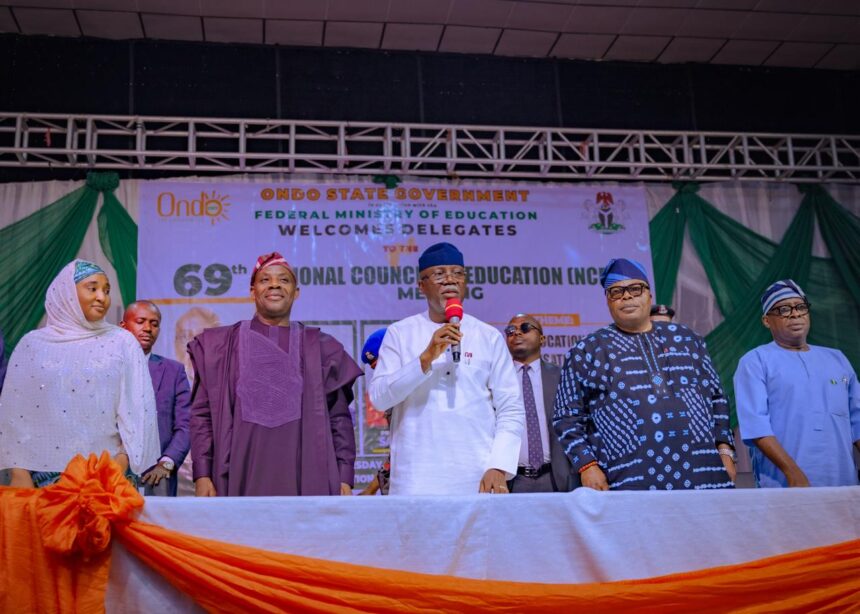
Speaking at the opening ceremony of the 69th National Council on Education (NCE) meeting held at The Dome, Akure, the Governor said education remains the most powerful instrument for social mobility, national unity, and sustainable development.
Aiyedatiwa emphasized that Ondo State’s enviable legacy in education dates back to the free education policy of the old Western Region, noting that his government is sustaining that tradition through investments in digital learning tools, teacher welfare, and school infrastructure.
“Our goal is to make education not just accessible, but meaningful and transformative,” the Governor declared. “Every child in Ondo State deserves a fair chance at learning and success.”
He commended President Bola Ahmed Tinubu for introducing key reforms such as the Nigerian Education Loan Fund, which has provided support for over 624,000 students across the country, bridging the gap between children of the rich and the poor.
Governor Aiyedatiwa also praised the Minister of Education, Dr. Olatunji Alausa, and the Minister of State for Education, Professor Suwaiba Sa’idu Ahmad, for their efforts in promoting innovation, accountability, and data-driven growth in Nigeria’s education system.
Describing the theme of the meeting –“Quality Education Data and Professionalisation of Teaching: Tools for Enhanced National Development” , as timely, the Governor noted that credible data remains the foundation for effective planning, resource allocation, and performance evaluation in the sector.
He lamented the declining value of the teaching profession, calling for improved welfare, merit-based recognition, and continuous professional growth to restore dignity to teachers.
“Teachers are the bedrock of national progress. When they are empowered, the nation prospers,” he added.
Aiyedatiwa highlighted several interventions under the OUR EASE education policy, including the recruitment and training of over 2,100 teachers, payment of annual examination fees, distribution of 75,000 textbooks, and rehabilitation of classrooms and laboratories across the state.
He also disclosed that the state had paid all counterpart funds up to 2024 to access UBEC/SUBEB grants and continued to invest in bursaries, scholarships, digital skills centres, and free school shuttle services.
“We are building a future where no child will be left behind, where technology drives learning, and where our schools become centres of excellence,” the Governor affirmed.
In his remarks, Minister of Education, Dr. Olatunji Alausa, announced the approval of the National Education Repository and Databank (NERD) , a digital platform designed to collect and preserve academic records nationwide.
He also disclosed plans to eliminate certificate fraud through the National Credential Verification System, while enhancing the global recognition of Nigerian credentials.
The minister revealed that 21 states had already uploaded data into the Digital Nigerian Education Management Information System (DNEMIS), integrated with the National Identity Management Commission (NIMC) for learner tracking.
On her part, Minister of State for Education, Prof. Suwaiba Sa’idu Ahmad, commended Ondo State for hosting the meeting, stressing that data reliability and teacher professionalism remain central to achieving educational excellence.
Earlier, Ondo State Commissioner for Education, Prof. Igbekele Ajibefun, highlighted the state’s digital migration of all school records to enhance transparency, planning, and governance.
The event was attended by top government officials including the Speaker of the Ondo State House of Assembly, Rt. Hon. Olamide Oladiji, Secretary to the State Government, Dr. Taiwo Fasoranti, Chief of Staff, Prince Segun Omojuwa, and traditional rulers led by the Olowo of Owo, Oba Ajibade Gbadegesin Ogunoye.
With Ondo State hosting the 69th NCE meeting, education stakeholders expressed optimism that the deliberations will yield practical outcomes to strengthen Nigeria’s learning system and prepare students for a digital future.