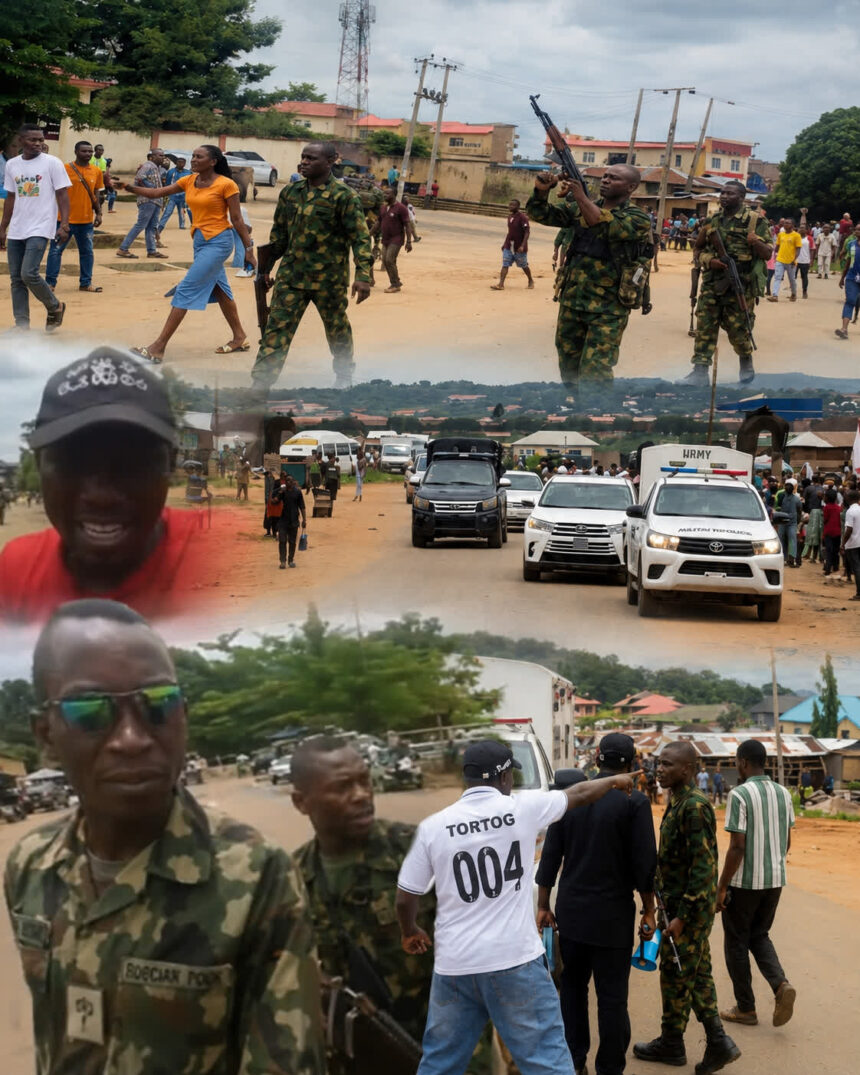
Hundreds of students of Adekunle Ajasin University, Akungba-Akoko (AAUA), Ondo State, narrowly escaped death when security personnel, including armed soldiers, were deployed to disperse a peaceful protest over an ongoing 68-day industrial strike.
The demonstration, organized by the Students’ Union Government (SUG), paralyzed vehicular movement along major highways and blocked the university’s main entrance as angry youths demanded an immediate end to the prolonged closure of their institution.
Tensions escalated rapidly when armed military units arrived at the scene to clear the student-erected barricades, firing live rounds into the air to force the crowd to scatter, sending hundreds of fleeing students scrambling for safety amidst chaos.
The dramatic military intervention has sparked fierce public outrage, with student leaders directly pointing accusing fingers at the Governor Lucky Aiyedatiwa-led Ondo State administration for weaponizing state security forces against unarmed citizens.
Student representatives condemned the governor’s decision to authorize a heavy-handed military force to quell a legitimate, peaceful exercise of their constitutional right to protest. Rather than engaging directly with university labor unions to resolve the 68-day deadlock, the state government faced criticism for resorting to armed intimidation against students who were merely asking to resume their education.
The shut down of academic activities at AAUA stems from unresolved labor conflicts involving the Academic Staff Union of Universities (ASUU) alongside non-teaching staff unions, including SSANU, NASU, and NAAT. The labor unions embarked on the industrial action following the non-implementation of financial agreements, unpaid salary arrears, and broader subvention disputes with the Ondo State Government.
SUG President Folagbade Greatness Ayoola and General Secretary Oluwatimileyin Amos emphasized that students have endured 68 days of frustration and academic stagnation, pushing their career timelines back and inflicting severe psychological strain.
Human rights advocates, civil society groups, and concerned citizens across the nation have voiced strong condemnation over the deployment of combat soldiers against student demonstrators.
Analysts warn that introducing armed military units into civilian protest environments creates an extreme risk of lethal force, accidental shootings, and tragic loss of life.
As public pressure mounts on Governor Aiyedatiwa, stakeholders demand an immediate transparent investigation of the unfortunate incident and urge the administration to prioritize peaceful dialogue with the striking varsity unions to ensure the safety of students and the urgent reopening of the university.