

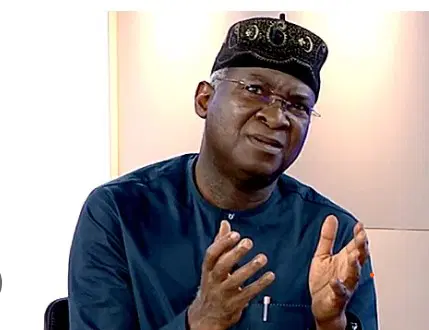
Former Lagos State Governor and Senior Advocate of Nigeria (SAN), Babatunde Raji Fashola, has dismissed suggestions that the appointment of the Independent National Electoral Commission (INEC) Chairman by President Bola Ahmed Tinubu automatically compromises the commission’s independence ahead of the 2027 general elections.
Fashola made the remarks during an interview with ARISE News, where he challenged critics questioning the impartiality of INEC Chairman, Professor Joash Amupitan, on the grounds that he was appointed by an incumbent president expected to contest for re-election.
Questioning the basis of such criticism, the former Minister of Works and Housing asked: “Which INEC chairman has not been appointed by the president?”
He argued that public scrutiny of electoral credibility should extend beyond the person occupying the office of INEC chairman to the activities of officials and other stakeholders responsible for conducting elections across the country.
Explaining the chairman’s responsibility during a presidential election, Fashola noted that the INEC chairman serves as the Chief Returning Officer, receiving results collated through the electoral structure from the various states before making the final declaration.
“In the presidential election, he’s the returning officer. As returning officer, what does he do? He sits in that conference hall, or wherever he designates, and waits for the results to come from the states,” he said.
Fashola maintained that the chairman does not personally supervise voting, counting and recording of results at polling units across Nigeria, arguing that electoral integrity depends on the conduct of several categories of officials and participants throughout the process.
He specifically drew attention to the activities taking place at polling units, where votes are cast, counted and recorded before results move through the different collation levels.
According to him, Nigeria has 176,846 polling units across 8,809 electoral wards and 774 local government areas in the 36 states and the Federal Capital Territory.
During the interview, Fashola referred to approximately 176,840 polling units while illustrating the scale of election administration and the difficulty of ensuring uniform conduct across thousands of locations. INEC’s official figure, however, is 176,846.
He argued that electoral failures should not automatically be attributed to the INEC chairman without examining the conduct of those directly involved in the process.
“It’s never a perfect undertaking. 176,000 people can’t behave the same way in 176,000 different locations,” he stated.
Fashola also urged Nigerians to take greater responsibility for protecting their votes by remaining at polling units to observe the counting and recording of results rather than leaving immediately after voting.
His comments come amid renewed debate over the independence of INEC and the credibility of the 2027 general elections, particularly because President Tinubu is expected to seek another term in office.
Under Section 154 of the 1999 Constitution, as amended, the President appoints the INEC chairman and national commissioners, subject to Senate confirmation and the applicable constitutional consultation requirements.
The appointment arrangement has continued to attract criticism from opposition politicians and electoral reform advocates, who argue that allowing an incumbent president to nominate the head of the institution responsible for conducting an election in which he is a contestant creates a potential conflict-of-interest perception.
They have consequently called for stronger institutional safeguards, transparent appointment procedures and greater financial and operational independence for the electoral commission.
The Justice Muhammadu Uwais Electoral Reform Committee had also recommended changes to the appointment structure of INEC leadership as part of broader efforts to strengthen electoral independence.
President Tinubu nominated Professor Joash Ojo Amupitan, SAN, as INEC chairman in October 2025. Following Senate confirmation, he was sworn into office on October 23, 2025, succeeding Professor Mahmood Yakubu.
Although Fashola’s argument places considerable emphasis on the responsibilities of polling officials and other electoral stakeholders, the INEC chairman remains responsible for providing institutional leadership and ensuring that the commission discharges its constitutional duties.
The commission’s responsibilities include election planning, logistics coordination, enforcement of electoral regulations, result collation and the declaration of election outcomes.
Consequently, the credibility of the 2027 elections will depend not only on the conduct of officials at polling units but also on the transparency, impartiality and accountability of INEC’s national leadership.
As political parties intensify preparations for the elections, Fashola’s intervention has added another dimension to the debate over whether Nigeria’s electoral credibility should be judged primarily by the appointment of the electoral umpire or by the overall conduct and transparency of the electoral process.






, Babatunde Raji Fashola, has dismissed suggestions that the appointment of the Independent National Electoral Commission (INEC))