


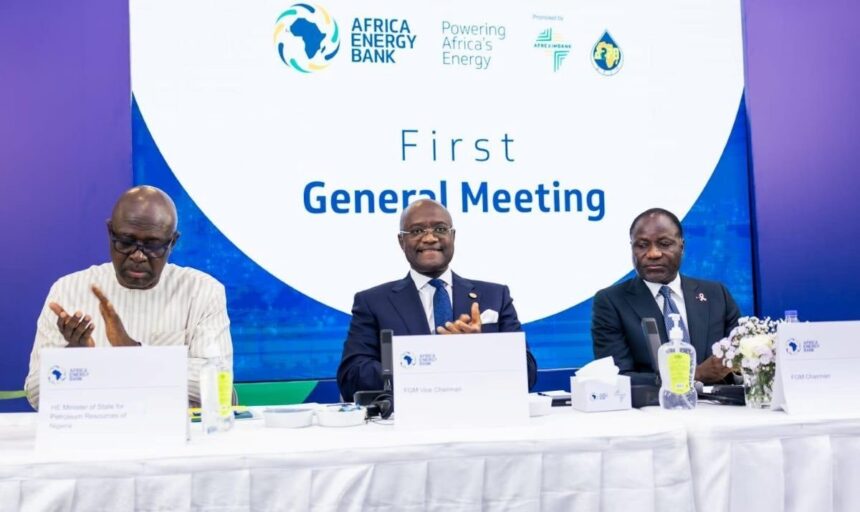
The Africa Energy Bank (AEB) has officially commenced operations with an initial capital of $5 billion, establishing its permanent headquarters in Abuja, Nigeria. Established jointly by the African Petroleum Producers Organization (APPO) and the African Export-Import Bank (Afreximbank), the multilateral institution is designed to bridge the continent’s immense energy infrastructure funding gap at a time when Western financial institutions are pulling back from fossil fuel investments.
The bank intends to finance 20 to 30 liquefied natural gas (LNG), pipeline, terminal, and refining projects by 2030, with natural gas projects targeted as a critical transition fuel taking roughly 40% of the loan portfolio. A primary operational objective is generating economic impact across the continent by prioritizing projects that support between 500,000 and 1,000,000 direct and indirect jobs throughout the energy value chain.
To expand liquidity and unlock local capital, the bank has raised the prospect of listing shares in national oil companies and landmark private industrial assets, such as the Dangote Refinery. By facilitating capital market listings and asset monetization, the institution projects growing its balance sheet toward $120 billion in assets within three to five years. The establishment of the bank in Abuja serves as a major milestone for Africa’s financial autonomy, positioning the continent to self-fund its energy transition while maximizing its vast hydrocarbon resources.
The operational rollout of the Africa Energy Bank carries significant advantages for Nigeria and the broader African continent:
For Nigeria, hosting the bank’s headquarters in Abuja strengthens the country’s position as the primary energy and financial hub of West Africa. It provides Nigerian oil and gas operators, midstream developers, and refiners with direct, prioritized access to foreign currency loans and long-term capital tailored to regional needs. The institution’s support for major local assets, such as the Dangote Refinery and domestic gas processing facilities, accelerates Nigeria’s transition from a raw crude exporter into a refined petroleum product exporter. Furthermore, the bank’s capital deployment inside Nigeria will spur domestic job creation, stimulate ancillary services in banking, logistics, and engineering, and bolster foreign exchange inflows.
For other African nations, the bank offers a crucial lifeline against strict international environmental, social, and governance (ESG) restrictions that have choked off traditional cross-border capital for fossil fuel and gas development. Gas-rich nations like Mozambique, Senegal, Angola, Algeria, and the Republic of Congo now gain access to dedicated funding for pipeline infrastructure, offshore exploration, and regional power projects. By focusing heavily on natural gas as a transition fuel, the bank enables African countries to harness domestic resources to eliminate energy poverty, deliver stable power supply, and drive regional industrialization.
Additionally, public listings of national oil companies on African exchanges will deepen local capital markets, attract intra-African investment, and foster greater corporate transparency across the continent’s energy sector.





 has officially commenced operations with an initial capital of $5 billion)