
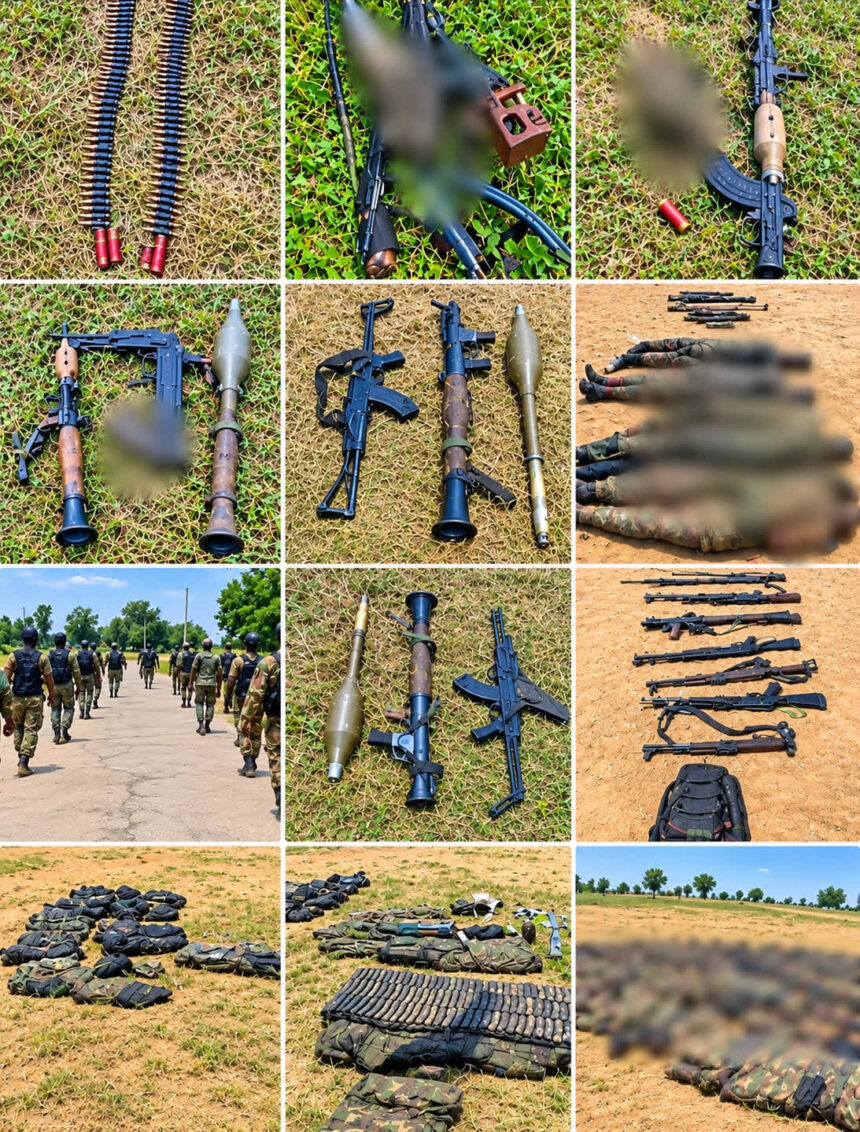
In a decisive battlefield outcome that reflects a transforming national security landscape, troops of Operation Hadin Kai have successfully repelled coordinated attacks by insurgents in Buni Yadi, Yobe State, and Bitta, Borno State, neutralizing 48 ISWAP terrorists and recovering an expansive cache of high-caliber combat weapons and heavy ammunition.
During the five-hour night engagement, military forces utilized integrated Intelligence, Surveillance, Target Acquisition and Reconnaissance capabilities alongside air interdiction assets to defeat the assailants, recovering 42 AK-47 rifles, five PKT machine guns, four General Purpose Machine Guns, a 60mm mortar, 105 magazines, and thousands of specialized rounds.
The swift containment and counter-offensive highlight what the administration under President Bola Ahmed Tinubu is doing right as it systematically overhauls Nigeria’s defense architecture through hardware expansion, personnel welfare, and structured recruitment across all security arms.
Central to these operational victories is the Federal Government’s aggressive push to equip the Armed Forces with advanced technology and aerial superiority. The battlefield victory in Yobe comes on the heels of President Tinubu’s formal induction of five new helicopters into the Nigerian Air Force fleet, comprising three AW109 Trekkers and two Airbus H125 helicopters, designed to bolster close-air support, rapid troop insertion, and continuous reconnaissance over volatile corridors. With over 60 additional aerial platforms scheduled for delivery alongside modern armored hardware, frontline formations are gaining real-time operational flexibility that leaves insurgents with fewer safe havens across the North-East and North-West theatres.
Equally critical to the rising operational tempo is the administration’s sustained investment in human capital and troop morale across the security sector. Beyond hardware procurement, President Tinubu’s administration has prioritized comprehensive welfare packages, including regularized field allowances, upgraded medical support, and modern housing facilities for frontline personnel.
These welfare initiatives are reinforced by steady recruitment drives into the Nigerian Army, Navy, Air Force, Police, and paramilitary agencies, directly addressing historical manpower deficits and preventing combat fatigue.
The tactical discipline, resilience, and high morale displayed by troops in neutralizing the ISWAP assault demonstrate that strategic defense spending, proactive personnel management, and modern hardware integration are delivering concrete security results across the nation.