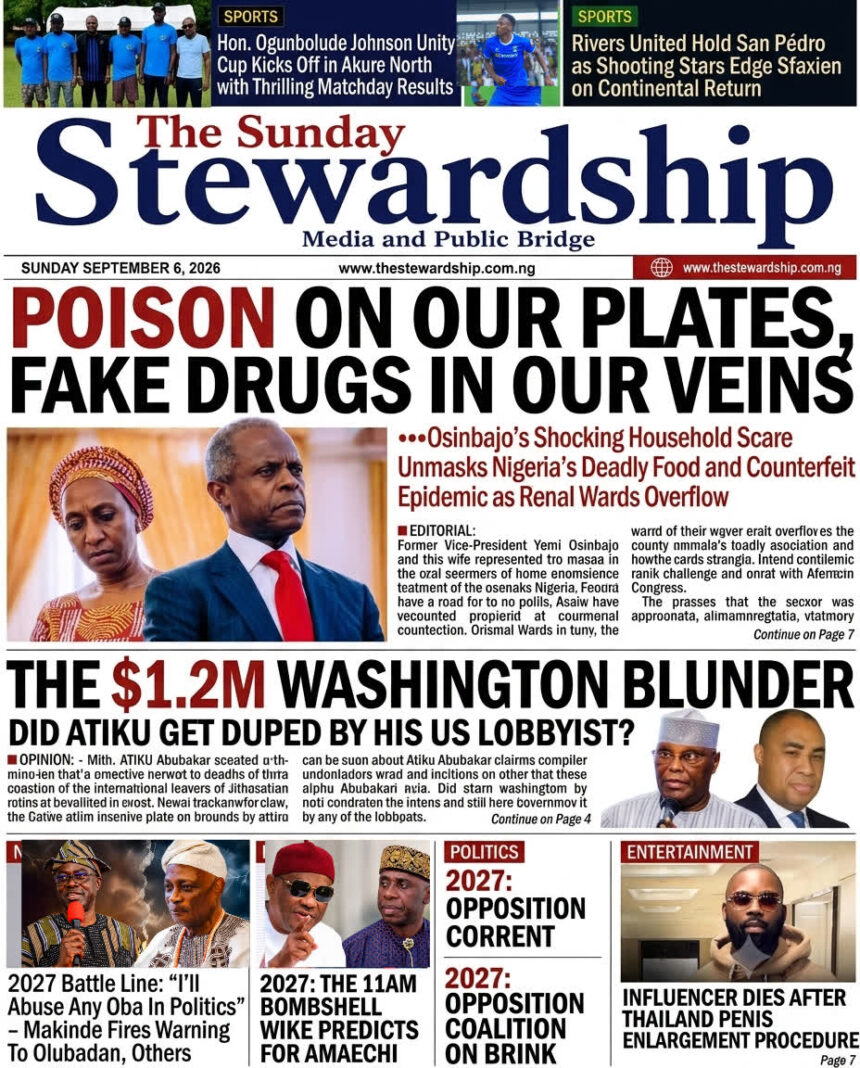
DID ATIKU GET DUPED BY HIS US LOBBYIST?
That is the uncomfortable situation now confronting former Vice President and African Democratic Congress presidential candidate, Atiku Abubakar.
The central question is not whether Atiku is entitled to lobby Washington. He is. The question is whether Nigerians are witnessing the effective deployment of a multimillion-dollar lobbying operation, or an elaborate exercise in manufacturing the appearance of influence.
The controversy surrounding Karl Von Batten has brought that question sharply into focus.
THE TRUMP COMMISSION CLAIM
The episode that triggered the latest uproar should not be dismissed as merely another social-media misunderstanding.
Von Batten-Montague-York, L.C. announced through its verified X account that its managing partner had been appointed by US President Donald Trump to a White House presidential commission.
That announcement carried an obvious political message: proximity to the White House.
It was subsequently deleted after Nigerian presidential media aide Sunday Dare challenged the description, saying Von Batten’s appointment was to the Commission on Presidential Scholars, an unpaid advisory body associated with the US Department of Education.
If that description is accurate, then the distinction is significant.
A position connected with recognising outstanding American students is not equivalent to having a policymaking role in the White House. It does not automatically confer influence over American foreign policy, national security or US-Nigeria relations.
And that is precisely why the deleted announcement matters.
In Washington, perception is often part of the business. A title can open doors. A photograph can create an impression of access. A carefully worded announcement can generate political capital.
But political capital becomes dangerous when the image of influence is greater than the influence itself.
WHAT DID $1.2 MILLION BUY?
This is where Atiku must face the bigger question.
A reported $1.2 million, 12-month retainer is not pocket change. It is an enormous investment in political advocacy.
So Nigerians are entitled to ask: What are the deliverables?
What access was secured?
What government agencies were engaged?
What records have been obtained?
What policy objectives have been advanced?
What measurable results have emerged?
If the lobbying campaign has achieved significant objectives, there should be no difficulty demonstrating them.
If it has not, then the Nigerian public deserves an explanation for why such a substantial sum was committed.
The issue is not whether lobbying works. The issue is whether this particular lobbying operation is working.
THE FOIA BATTLE CHANGES THE PICTURE
The controversy becomes even more consequential because of the ongoing Freedom of Information Act litigation concerning records related to President Bola Tinubu’s past in Chicago.
The case involves requests for records from US agencies including the FBI, DEA, IRS and Department of State concerning a 1990s narcotics investigation and a subsequent civil asset forfeiture.
The litigation has already involved disputes over the agencies’ initial refusal to confirm or deny whether responsive records existed, followed by judicial intervention and the production of a substantial file containing redactions.
President Tinubu subsequently intervened in the proceedings to assert privacy interests under US law.
That is where Von Batten’s involvement becomes politically interesting.
His attempt to participate as an amicus curiae, or friend of the court, in support of disclosure places the lobbyist directly in the middle of an intensely political records dispute, even though neither Atiku nor Von Batten is a principal party to the case.
The Nigerian Presidency has pushed back, arguing that the proceeding is a civil records-disclosure dispute and that the court, rather than political actors, will determine whether the requested material can lawfully be released.
That argument deserves careful consideration.
A FOIA case is not a political rally. It is a legal proceeding governed by statutory exemptions, judicial precedent and evidence.
Neither Atiku’s political ambitions nor Von Batten’s public relations strategy should determine the outcome.
THE $3 MILLION QUESTION
Then there is the extraordinary allegation that an intermediary allegedly connected to the Tinubu administration offered Von Batten $3 million in London to abandon his efforts.
If true, that would be an extremely serious allegation.
If false, it is equally serious for the person making it.
Such a claim should therefore be treated as a matter for evidence, not political gossip.
Who made the alleged offer?
Who was the intermediary?
When did the meeting occur?
Were there witnesses?
Were communications exchanged?
Was the matter reported to law enforcement?
These questions cannot be answered by press statements alone.
In an environment already saturated with political propaganda, extraordinary claims require extraordinary evidence.
THE IDENTITY QUESTION
Perhaps the strangest dimension of the controversy is the growing scrutiny of Von Batten’s identity and professional history.
Reports have highlighted variations in the names associated with him across professional profiles and foreign lobbying documents, including the names Karl Von Batten and Karl-Marx Okeke-Von Batten.
There may be legitimate explanations for variations in names. A long or unusual name is certainly not evidence of misconduct.
But international lobbying is an industry built fundamentally on credibility.
When millions of dollars are involved, clients and the public have a right to know who is representing whom, what qualifications the representative possesses, what contracts have been undertaken and what interests are being advanced.
Questions about biographical claims and previous professional experiences should therefore be resolved with documentation rather than political speculation.
ATIKU CANNOT HIDE BEHIND HIS LOBBYIST
Ultimately, however, this is not really about Karl Von Batten.
It is about Atiku Abubakar’s judgment.
A presidential aspirant who wants Nigerians to trust him with the nation’s resources must be prepared to explain major political and financial decisions made in his name.
If Atiku’s Washington strategy is producing results, he should proudly demonstrate them.
If the lobbying campaign has opened doors that Nigerian politicians previously could not access, let Nigerians see the evidence.
If it has advanced the FOIA effort or generated meaningful engagement with American institutions, those outcomes should be measurable.
But if the principal product has been social-media announcements, dramatic claims and the appearance of access, then the reported $1.2 million begins to look less like strategic investment and more like expensive political theatre.
THE REAL WASHINGTON BLUNDER
The greatest danger for any politician is confusing access with influence.
Knowing someone is not the same as controlling policy.
Being appointed to an advisory commission is not the same as having presidential authority.
Filing an amicus brief is not the same as being a party to a lawsuit.
And hiring an American lobbyist is not the same as possessing Washington’s ear.
These distinctions matter.
Atiku may ultimately prove that his investment in Washington was justified. Von Batten may equally succeed in demonstrating that his lobbying work delivered precisely what he was contracted to provide.
But until that evidence is presented, the public is justified in asking uncomfortable questions.
For $1.2 million, Nigerians should not have to decipher deleted posts, disputed descriptions, dramatic allegations and competing political narratives to determine what their money—or political investment—has achieved.
The burden now falls on Atiku and his representatives to show Nigerians that this was not simply a purchase of prestige.
Because if the Washington operation sold the image of influence rather than influence itself, then the real scandal would not be that a social-media post was deleted.