

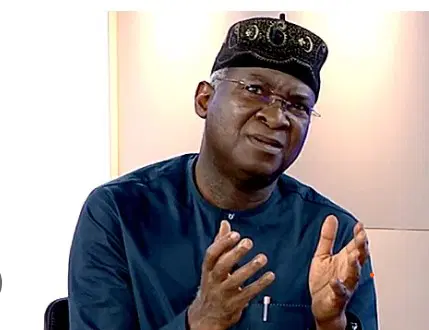
Former Lagos State Governor and Minister of Works and Housing, Babatunde Fashola, has challenged the international narrative portraying Nigeria as a country defined by corruption, arguing that foreign financial institutions and global networks also play significant roles in concealing and benefiting from illicit wealth.
Fashola made the observation during a recent television appearance while responding to the controversial description of Nigeria as “fantastically corrupt.” In his response, the former governor suggested that the expression was coined by those who “know how to fantastically keep stolen goods.”
His remark has reignited conversations about the international dimensions of corruption, particularly the role of foreign financial centres, offshore accounts and institutions that provide channels through which proceeds of corruption are transferred, concealed and invested outside the countries where they originate.

For decades, Nigeria and several other African countries have faced international criticism over corruption, weak institutions and the mismanagement of public resources. However, Fashola’s intervention draws attention to what critics describe as an overlooked aspect of the problem: the international networks that make it possible for stolen public funds to find safe destinations abroad.
Investigations into high profile corruption cases involving Nigerian public officials have repeatedly exposed the use of foreign bank accounts, offshore companies, luxury properties and complex financial arrangements to conceal illicit wealth. The recovery of such assets has also remained a major challenge, with the Nigerian government often required to pursue lengthy legal proceedings and diplomatic negotiations before securing the return of funds.
Beyond financial transactions, the problem extends to the illegal exploitation of natural resources, particularly crude oil and solid minerals. Large scale oil theft and illegal mining operations depend on networks of financiers, transporters, buyers and intermediaries capable of moving illegally obtained resources into domestic and international markets.
The activities raise questions about the responsibility of foreign buyers, commodity traders, shipping operators and other commercial interests that may knowingly facilitate the trade in stolen natural resources. Without international cooperation and effective monitoring of these transactions, efforts to tackle resource theft will remain limited.
The connection between illegal resource exploitation and insecurity has also become a growing concern in parts of Africa. In Nigeria, illegal mining, banditry, arms trafficking and oil theft have raised questions about the financial and logistical networks sustaining criminal operations. Addressing these challenges requires investigations that extend beyond local perpetrators to the wider networks that finance, transport and profit from such activities.
Fashola’s observation, however, does not diminish the responsibility of Nigerian leaders and public officials to account for their actions. Rather, it highlights the need for a broader approach that recognises corruption as an international problem requiring accountability across national borders.
While Nigeria must strengthen its institutions, improve transparency and prosecute public officials involved in financial misconduct, foreign governments must equally ensure that their financial systems do not become safe havens for stolen African wealth.
The former governor’s remarks have therefore brought renewed attention to the need for a balanced global anti-corruption campaign, one that holds accountable not only those who steal public funds but also the institutions and individuals who knowingly receive, conceal or profit from the proceeds.
Ultimately, the fight against corruption cannot be won by focusing exclusively on the countries where public resources are stolen while ignoring the international financial and commercial networks that help preserve the proceeds.
As Fashola’s pointed remark suggests, the fight against corruption must address both sides of the transaction: the thief and the willing receiver.