

•••From Courtrooms To Streets: Dino Melaye’s ‘All Die Na Die’ Outburst Revives Fears Of Another Operation Wetie
Nigeria’s political atmosphere is becoming increasingly tense a the 2027 general election approaches. From the prolonged legal battles rocking opposition parties to allegations of political interference, accusations against the ruling All Progressives Congress (APC) and increasingly combative declarations by opposition figures, the country’s multiparty democracy is facing another serious test.
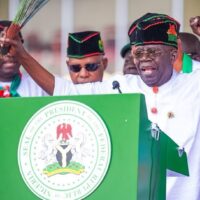
At the centre of the controversy is President Bola Ahmed Tinubu, whose administration has repeatedly been accused by opposition leaders of exploiting political and institutional power to weaken rival parties. While the Presidency and the APC have rejected allegations of orchestrating opposition crises, the frequency of these accusations, particularly from prominent opposition figures, raises questions that should not be dismissed without scrutiny.

Could Tinubu be behind the opposition’s court woes? Is the ruling party benefiting from the legal and leadership crises confronting its major rivals? And, more importantly, is Nigeria’s political class beginning to travel down a dangerous road where disagreements over political power could eventually spill into the streets?
These questions have become more pressing following the latest judgment of the Federal High Court in Abuja, which on Thursday, November 5, nullified the David Mark-led leadership of the African Democratic Congress (ADC) and the processes that produced former Vice President Atiku Abubakar as the party’s presidential candidate.
The judgment, delivered by Justice Peter Lifu, followed a suit instituted by Nafiu Bala Gombe, a former deputy national chairman of the party, who challenged the process through which Mark and other leaders emerged. The court ruled against the Mark-led leadership and invalidated decisions taken under it, including the presidential primary that produced Atiku.
The timing could hardly have been more politically sensitive. The judgment came barely a day after Atiku launched his presidential campaign in Sokoto, raising fresh uncertainty over the ADC’s preparations for the 2027 elections.
The party has rejected the ruling, insisting that an earlier judgment delivered by another Federal High Court judge, Justice Musa Liman, on July 2, had recognised the Mark-led leadership. It has also argued that a court of coordinate jurisdiction cannot sit on appeal over the decision of another court of equal jurisdiction. The ADC has vowed to challenge the latest judgment at the Court of Appeal.
Atiku, in his reaction, accused the Tinubu administration of deploying political pressure, manufactured narratives and courtroom manoeuvres to weaken opposition parties. In a strongly worded statement, he declared that the President could not use the courts to escape the judgment of Nigerians at the ballot box.
“We are on the ballot, and the people must be allowed to decide,” Atiku insisted, adding that he would not abandon the race despite the latest legal development.
He went further to allege that attempts were being made to push Nigeria towards a one-party state, arguing that a government confident in its performance should have no reason to fear a competitive election.
But this is not the first time Atiku has pointed accusing fingers at Tinubu over what he considers attempts to undermine opposition politics.
Earlier in 2026, when the Nigeria Democratic Congress (NDC) faced a legal challenge that threatened its registration, Atiku accused the President of pursuing a one-party agenda through the courts. The dispute followed a Federal High Court decision in Lokoja that set aside an earlier judgment directing the Independent National Electoral Commission (INEC) to register the NDC.
The development generated concern among supporters of the emerging opposition platform, particularly as the party was positioning itself for the 2027 elections.
However, the NDC eventually secured a significant legal reprieve. On September 18, 2026, the Court of Appeal in Abuja, in a split 2–1 decision, overturned the Lokoja judgment and restored the effect of the original order directing INEC to register the party.
The appellate court held that the lower court had improperly revisited its earlier judgment. The ruling was a reminder that the judicial process can also provide relief to opposition parties when they challenge decisions they consider unjust.
Yet, the ADC’s latest experience has renewed the debate over whether opposition parties are being subjected to a pattern of legal and political pressures that could undermine their ability to compete.
Peter Obi, who has also experienced a prolonged political struggle within the Labour Party, has made similar allegations against Tinubu.
In June 2025, Obi accused the Tinubu administration of instigating and sustaining the crisis within the Labour Party. Speaking during an interview on Arise News, he described the party’s internal turmoil as a problem allegedly created and sustained by the government of the day.
The former Anambra State governor’s accusation came amid the bitter leadership dispute that rocked the Labour Party after the 2023 general election, eventually contributing to his departure from the party.
Now, following the ADC judgment, Obi has again accused the ruling APC of engineering instability within opposition parties. In his reaction to the latest ruling, he alleged that the same political playbook used against him in the Labour Party was being deployed to restrict the opposition’s political space.
He argued that democracy should allow voters, rather than court disputes, to determine who leads the country, while expressing concern about the uncertainty created by the judgment so close to the general election.
The repeated accusations by Obi and Atiku are politically significant. They suggest that leading opposition figures increasingly view the crises confronting their parties not merely as internal disagreements but as part of a wider struggle over the survival of opposition politics.
However, allegations are not proof. The NDC and ADC cases arose from different legal disputes, with different claimants, arguments and judicial decisions. In the ADC matter, the plaintiff challenged the legitimacy of the party’s leadership transition, while the NDC’s registration dispute involved a separate challenge concerning the earlier proceedings and its party logo.
It would therefore be premature to conclude that the Presidency orchestrated either case simply because the outcomes affected opposition parties. Political parties must also take responsibility for their constitutions, internal elections, leadership succession arrangements and the legal consequences of decisions taken by their officials.
Nevertheless, the ruling APC cannot simply dismiss every concern as an opposition excuse. When major opposition figures repeatedly raise allegations of political interference, the government has a responsibility to demonstrate, through transparency and respect for democratic institutions, that it is not using state power to narrow the political space.
The APC has consistently rejected such allegations. Following Obi’s latest accusation over the ADC judgment, the party’s National Publicity Secretary, Felix Morka, questioned why opposition politicians celebrate the judiciary when judgments favour them but accuse the APC whenever decisions go against them.
That argument deserves consideration. Opposition parties cannot demand respect for the rule of law only when court decisions suit their interests. Equally, the ruling party must not treat every criticism of the political environment as an attempt to discredit the government.
But perhaps the most troubling dimension of this unfolding political drama is no longer confined to the courtroom. It is the increasingly confrontational language coming from political actors and the possibility that frustration with the judicial process could translate into street resistance.
On November 3, Senator Dino Melaye, a deputy director-general of the ADC Presidential Campaign Council, issued a warning to the APC and the Tinubu administration over what he described as attacks, intimidation and harassment of opposition members.
Speaking on Arise News, Melaye declared that the ADC would no longer remain silent if its members were attacked. He alleged that opposition politicians and supporters had suffered violence in different states, including Sokoto, Kaduna, Katsina and Kogi.
His most controversial declaration was that the party would no longer rely on the courts to settle certain disputes if similar incidents occurred during the coming elections.
“We will not go to court; we will settle the matter on the streets,” he said, adding the now widely circulated phrase, “All die na die.”
Although Melaye insisted that the ADC was a non-violent party and described self-defence as a constitutional right, his language raises serious concerns. Political resistance and the right to defend oneself against an attack are not the same as encouraging a situation in which electoral disagreements are settled through street confrontation.
Coming against the backdrop of the latest judgment affecting the ADC, the statement is particularly worrying. When a leading opposition figure publicly suggests that the courts may no longer be the preferred avenue for resolving political disputes, it raises questions about confidence in the country’s democratic institutions.
And this is where Governor Seyi Makinde’s earlier warning about Operation Wetie becomes relevant.
At the National Summit of Opposition Political Party Leaders held in Ibadan on April 25, 2026, Makinde warned against what he described as the growing concentration of political power in one party and the weakening of opposition structures.
The Oyo State governor argued that democracy without a credible opposition could gradually lead to a one-party state. He cautioned political actors who behaved as though there would be no consequences for their actions to remember the history of Operation Wetie, which began in Ibadan.
“For those that are carrying on as if there’s no tomorrow, they should remember that ‘Operation Wetie’ started from here. This is the same Wild Wild West,” Makinde said.
His remarks immediately generated controversy, with the APC accusing him of making comments capable of threatening national security. However, the PDP’s National Publicity Secretary, Ini Ememobong, defended the governor, explaining that the reference was intended as a historical warning, not a threat or a call for violence.
Makinde’s warning should not be treated lightly, especially given the history behind the expression.
Operation Wetie refers to the wave of political violence that engulfed Nigeria’s Western Region, particularly Ibadan, following the disputed 1965 regional elections. The violence involved the petrol-soaking and burning of political opponents, their homes and vehicles. It became one of the darkest episodes in the political history of the First Republic and contributed to the instability that preceded the military coup of January 1966.
It was not simply a disagreement between politicians. Ordinary Nigerians paid the price for the desperation, rivalry and breakdown of political order among the country’s political elite.
It is therefore disturbing that the expression has returned to contemporary political conversations, first through Makinde’s historical warning and now against the backdrop of Melaye’s declaration that the ADC would settle certain disputes on the streets.
Nigeria must not allow political disagreements to degenerate into a situation where violence becomes an alternative to the courts or the ballot box.
The country has already experienced the devastating consequences of political intolerance. The disputed elections of the First Republic, the violence that followed and the eventual collapse of democratic governance should have taught successive generations that political power is never worth the destruction of human lives and national institutions.
There is also a responsibility on the judiciary. Courts must remain independent, impartial and courageous in deciding disputes, irrespective of the political identities of the litigants. Judgments must be based on the law and evidence, not political pressure or public sentiment.
Where a party disagrees with a decision, the appropriate response is to pursue the available appellate process. The judiciary must equally ensure that political disputes are determined promptly, particularly when their outcomes could affect participation in an approaching general election.
The Presidency and the APC must also understand that the strength of a democracy is not measured by the number of governors, lawmakers or opposition politicians they can attract into their fold. It is measured by the ability of competing political parties to organise, campaign, criticise the government and seek power without intimidation or institutional obstruction.
At the same time, opposition leaders must resist the temptation to turn every internal disagreement or unfavourable court decision into evidence of a grand conspiracy. They must put their houses in order, respect due process and avoid rhetoric that could encourage supporters to take the law into their own hands.
The question of whether Tinubu is behind the opposition’s court woes remains one that must be tested against credible evidence, not merely political accusations. But the President cannot afford to ignore the atmosphere of distrust surrounding the political process. His administration has a duty to protect the institutions that guarantee free political participation, whether or not the allegations against it are justified.
Atiku, Obi, Makinde, Melaye and other opposition figures must also recognise that the language of political resistance carries consequences. A declaration made at a rally or television interview can be interpreted differently by supporters already frustrated by economic hardship, political exclusion and distrust in public institutions.
As 2027 approaches, Nigeria needs fewer threats, fewer inflammatory declarations and more commitment to democratic competition. Political leaders must remember that the country belongs to all Nigerians, not the party currently occupying the Presidency or those seeking to replace it.
Tinubu may insist that the APC’s growing political strength is the product of its appeal and the weakness of its opponents. The opposition may insist that the government is using state institutions to weaken its chances. Both claims must be subjected to evidence and public scrutiny.
But one thing should be beyond political argument: no ambition, court judgment, party crisis or electoral contest should become an excuse for bloodshed.
Operation Wetie must remain a lesson in Nigeria’s history, not a phrase that becomes a prophecy for its future.
The courts must decide legal disputes, the ballot box must determine political leadership, and the streets must remain places where Nigerians can exercise their democratic rights peacefully.
Nigeria has too much at stake to allow the desperation for political power to turn another election season into a national tragedy.