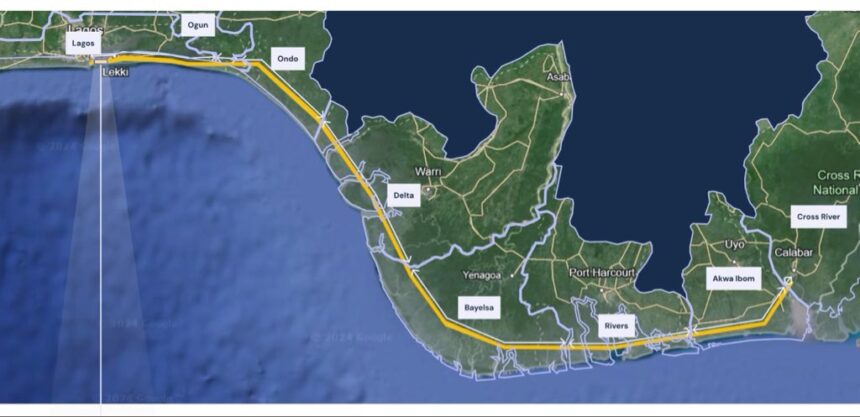
The flagship 700-kilometer Lagos–Calabar Coastal Highway project, championed as a transformational corridor to connect Nigeria’s western commercial epicenter directly with the South-South region, has run into a storm of political, socio-economic, and technical controversy.
At the heart of the uproar is the Federal Government’s official announcement that Sections 4A and 4B of the highway, covering roughly 67 kilometers across Ogun and Ondo states, will be realigned inland to link up with the existing East-West Road rather than hugging the oceanfront. This decision has pitted engineering pragmatism against public trust, regional equity, and governance credibility.
From the perspective of the Federal Ministry of Works, the inward diversion is an unavoidable, pragmatic engineering choice made to navigate hostile terrain. The Minister of Works, David Umahi, clarified that geotechnical surveys along the original oceanfront in Ondo uncovered treacherous mud pits exceeding 100 meters in depth, severe coastal erosion, and an absolute absence of suitable sharp sand up to 300 meters deep. Continuing along the original shoreline would have required sand-filling over 30 feet high, constructing numerous multi-kilometer bridges over complex swamps, and driving costs into astronomical figures with severe risks of structural failure.
By shifting the alignment to higher ground and elevating flood-prone segments of the East-West Road by two meters, the government argues it is saving taxpayers money, mitigating climate risks, and preventing a long-term engineering disaster while keeping the primary objective of connecting Lagos to Calabar intact.
However, citizens, urban planners, and civil society groups see a very different reality, accusing the government of shifting goalposts and eroding trust. The original concept presented to the public was an integrated 10-lane multimodal corridor with a central high-speed rail line. Merging the highway into the already narrow and congested East-West Road strips away the space required for a central rail line, turning what was marketed as a world-class superhighway into an upscale rural road expansion. Furthermore, with Section 1 in Lagos alone priced at over one trillion naira, critics question why total financial commitments remain so exorbitant when the physical scope and technical complexity of the project are being reduced.
A central point of outrage is the timing of this disclosure, which comes after significant progress and heavy investments were already made on the Lagos and Ogun ends of the highway. Critics point out that from the beginning, skeptics warned that the President Bola Ahmed Tinubu administration was primarily interested in prioritizing the Lagos segment to boost the state’s commercial visibility and service elite economic interests around the Lekki economic axis. The speedy execution of the Lagos stretch, contrasted with the sudden scaling back and inland rerouting once the project reached neighboring states, has led many to conclude that non-Lagos sections were treated as secondary PR leverage rather than genuine priority zones.
This late disclosure raises serious questions about the overall credibility of the administration and whether it can truly be trusted. Observers assert that it is highly improbable for top government officials and civil engineers to be unaware of the Niger Delta’s complex swamp terrain prior to launching the project. The prevailing sentiment among the public is that the federal authorities likely knew from the outset that an inward diversion would be necessary, but deliberately misled the public with grand visions of a continuous beachside superhighway to secure political buy-in and financial approvals without undergoing proper re-scoping protocols.
The biggest losers in this strategic shift are indisputably the coastal communities of Ondo State, particularly within the Ilaje local government area. For decades, these communities have suffered severe environmental degradation from oil exploration, shoreline erosion, and systemic infrastructural abandonment. The original coastal highway promised them a vital lifeline, direct access to deep-sea port prospects, maritime commerce, and shoreline protection. Diverting the road inland leaves these oil-producing host communities geographically isolated, bypassing major coastal towns like Ayetoro, Awoye, and Ugbonla.
In response, local stakeholders, traditional institutions, and community groups, such as the Ilaje Omuro Community Connect, have launched fierce protests, writing petitions and calling for an immediate presidential intervention and parliamentary probe into the realignment. They demand an open audit of the technical studies and insist that the people who bear the brunt of Nigeria’s oil wealth should not be quietly written out of national infrastructure plans.
The controversy has also turned a harsh political spotlight onto Ondo State Governor Lucky Aiyedatiwa. Critics argue that the governor failed to play effective national politics within the ruling party to safeguard his state’s interest, leaving Ondo’s coastal belt unprotected against federal re-routing.
Political opponents assert that while other state leaders actively lobby and maneuver to attract federal projects directly into their domains, Aiyedatiwa’s administration was caught off-guard, reacting passively to a major decision that strips his state of an historic shoreline infrastructure. His supporters, however, maintain that the choice was purely technical and executed at the federal ministry level beyond a governor’s direct control.
Despite the heavy disappointment, analysts note that the realignment does not completely leave Ondo State without benefits. The new inland hybrid corridor will still pass through parts of the Ondo-Edo axis, enhancing interstate road transport, improving security over land routes, and facilitating regional trade between the South-West and South-South regions.
However, while the realigned highway offers standard road connectivity, it completely fails to deliver the direct coastal urbanization, blue economy boost, and shoreline stabilization that the people of Ondo were promised. Until the government offers full transparency on contract re-scoping and engages deeply with affected host communities, the Lagos–Calabar Coastal Highway will remain as much a symbol of regional distrust as it is of civil engineering ambition.