
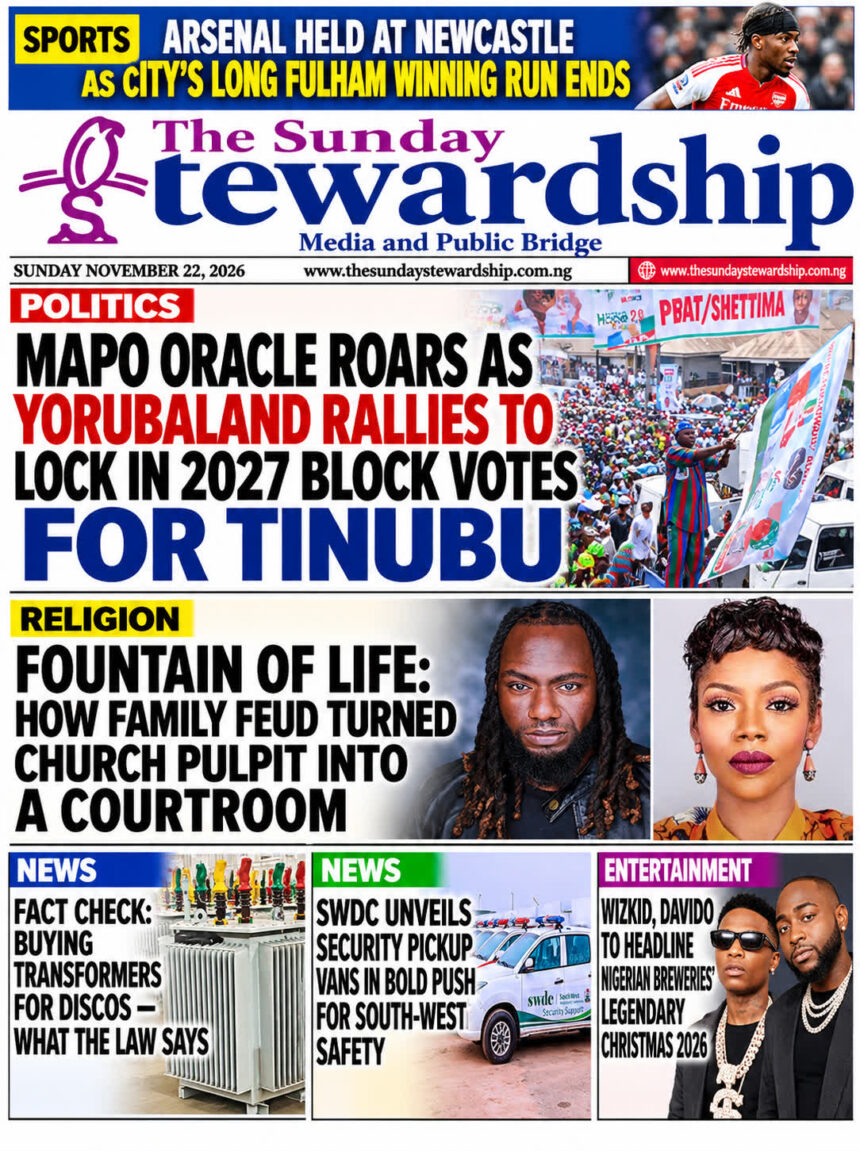
The unfolding crisis at The Fountain of Life Church, Lagos, is becoming an uncomfortable spectacle, not just for members of the congregation but for Christians and observers who have watched the once-respected ministry descend into a public leadership battle involving family members, church trustees and the courts.
What should ordinarily be an internal disagreement requiring wisdom, restraint and spiritual maturity has degenerated into competing claims, public statements, controversial revelations and legal proceedings.
At the centre of the controversy is Pastor Jimmy Odukoya, son of the church’s late founder, Pastor Taiwo Odukoya, whose emergence as successor in September 2023 appeared to have settled the question of who would lead the ministry following his father’s death.

However, barely three years after his appointment, that succession has become the subject of a bitter dispute involving his elder sister, Pastor Tolu Odukoya-Ijogun, and members of the church’s Board of Trustees.
The controversy has also drawn attention to Jimmy’s recent remarriage, reportedly becoming another source of disagreement between him and some church leaders.
But beyond the personalities involved, the crisis raises fundamental questions about the administration of religious institutions, the preservation of spiritual legacies and the responsibility of those entrusted with protecting them.
How did a church built on the principles of faith, love, forgiveness and reconciliation arrive at a point where its leadership is being contested in court?
The circumstances surrounding the emergence of Jimmy’s new wife, Pastor Mo Odukoya, and the reported tensions involving his sister, Tolu, have added another layer to the controversy.
Reports have alleged that Mo was previously close to Tolu, with some accounts describing her as a former friend of the senior pastor’s sister. Although the details surrounding their relationship and the alleged breakdown of their friendship remain matters requiring careful verification, the development has fuelled public conversations about the family dynamics behind the crisis.
However, personal relationships, regardless of how complicated they may become, should not be allowed to determine the administration of a spiritual institution.
A church’s leadership cannot be reduced to a contest of family loyalty, personal disagreements or individual preferences. There must be established rules, transparent procedures and clearly defined responsibilities.
Unfortunately, the Fountain of Life controversy appears to have exposed questions about whether those safeguards were sufficiently observed.
The succession video and the questions it raises
Perhaps the most troubling aspect of the unfolding crisis is the emergence of a succession video allegedly recorded by the late Taiwo Odukoya in December 2021.
In the recording, the founder reportedly named Pastor Kunle Areogun as his preferred successor should he die or become incapacitated. He also indicated that Jimmy should serve as Areogun’s immediate administrative assistant and head of the youth church.
The video, which has now become central to the leadership dispute, raises questions that the church’s trustees must be prepared to answer.
Where was this recording kept for more than two years after Taiwo’s death in August 2023? Who had custody of it? Why was it not presented when the board considered and announced Jimmy’s appointment as senior pastor in September 2023?
More importantly, why did it take until December 2025 for the trustees to reportedly become aware of a recording that could have fundamentally altered the succession process?
These are not insignificant questions.
The timing of the video’s emergence is particularly concerning because Jimmy had already been installed as senior pastor, while his sister, Tolu, was appointed associate senior pastor.
However, the controversy became even more complicated following Jimmy’s own explanation to church workers on November 19.
He reportedly admitted that he personally recorded the video at his father’s request but retained it after the late founder allegedly instructed him to delete it following his successful surgery.
Jimmy described keeping the recording as a grave mistake.
This admission raises another important question: if the founder subsequently instructed that the recording be deleted because the circumstances that prompted it had changed, should the initial declaration still be treated as an unquestionable succession directive?
Was the video intended to remain a permanent instruction, or was it a temporary arrangement pending the outcome of the founder’s surgery?
These are issues that deserve clarification, particularly because the recording itself reportedly acknowledged that aspects of the church’s constitution were undergoing review.
The trustees cannot simply rely on the video without explaining its history, the circumstances surrounding its retention and its relationship with the church’s governing constitution.
Equally, Jimmy’s decision to retain a recording he was allegedly instructed to delete raises questions about his judgment and transparency.
The bigger concern is that an issue with such far-reaching implications was apparently not resolved through a clear and transparent succession process before the founder’s death.
If Taiwo Odukoya had a preferred successor, why was there no properly documented and communicated transition arrangement that would have prevented the present confusion?
When personal disagreements become institutional crises
Another issue that deserves attention is the controversy surrounding Jimmy’s remarriage.
The Board of Trustees reportedly raised concerns about his marriage, arguing that it conflicted with the church’s teachings and the standards expected of its spiritual leader.
While religious institutions are entitled to establish moral and doctrinal standards for their leadership, such standards must be clearly defined and consistently applied.
The question is whether the circumstances surrounding Jimmy’s remarriage constitute grounds for removing him under the church’s constitution.
If they do, the relevant provisions should be made public and the prescribed disciplinary procedures followed.
If they do not, personal reservations should not be presented as sufficient grounds for removing an appointed spiritual leader.
There must be a distinction between personal disagreements and institutional misconduct.
The church cannot afford to allow its leadership structure to become an extension of unresolved family tensions.
From the pulpit to the courtroom
The crisis reached another level on November 18 when the Lagos State High Court issued an interim order restraining Jimmy from presenting himself as the church’s senior pastor and spiritual head.
The order followed an application by the Incorporated Trustees of the church and was made ex parte, meaning it was granted before Jimmy’s response to the application. He retains the right to challenge it.
Rather than allowing the matter to rest, Jimmy has now instituted another legal action at the Federal High Court in Lagos against his sister, Tolu, and eight other church figures over his removal.
The suit, marked FHC/LAG/CS/1568/2026, was filed on Friday.
The development further underscores how deeply the disagreement has fractured relationships within the institution.
It is particularly unfortunate that a ministry founded on the teachings of Christianity now finds itself embroiled in a dispute that requires judicial intervention.
Of course, seeking legal redress is a constitutional right, and nobody should be expected to surrender legitimate rights simply because the disagreement involves a religious institution.
Nevertheless, the question remains whether all available internal mechanisms for reconciliation, mediation and dispute resolution were exhausted before the disagreement escalated to this level.
Church leaders preach forgiveness, reconciliation and peaceful resolution of differences. Those principles should not become convenient messages reserved for congregations while those occupying positions of authority engage in prolonged public confrontations.
The postponement of the church’s 2026 Thanksgiving Service, originally scheduled for November 22, is another unfortunate development amid the crisis.
For members who have invested their faith, time, resources and loyalty in the ministry, the uncertainty must be distressing.
They deserve an institution whose leadership is guided by clarity, accountability and a shared commitment to its spiritual mission.
Who is protecting Taiwo Odukoya’s legacy?
Ultimately, this controversy should be bigger than Jimmy, Tolu, Mo, Areogun or the individual members of the Board of Trustees.
Pastor Taiwo Odukoya and his late wife, Pastor Bimbo Odukoya, founded the Fountain of Life Church in 1992. More than three decades later, the institution they built should not be allowed to become a casualty of disagreements among those expected to preserve its legacy.
The trustees must explain the circumstances surrounding the succession video, its custody and why it was not considered before Jimmy’s appointment.
Jimmy, on his part, must address the questions surrounding his handling of the recording and demonstrate a willingness to submit to transparent institutional processes.
The family members involved must also recognise that their personal relationships cannot be allowed to overshadow the interests of a congregation much larger than the family itself.
Above all, the church must demonstrate that its constitution is more important than individual interests and that its leadership decisions are guided by established rules rather than emotions or personal loyalties.
There is also a lesson for other religious institutions. Succession planning should never be left to assumptions, informal conversations or recordings whose status and custody become subjects of controversy after a founder’s death.
Religious organisations must establish clear succession procedures, properly document leadership decisions and ensure that trustees understand their responsibilities long before a transition becomes necessary.
The Fountain of Life Church now faces a defining moment. Its leadership must decide whether it wants to be remembered for a bitter succession battle or for the maturity with which it resolves one of the most challenging periods in its history.
The courts may eventually determine the legal questions surrounding the competing claims, but no court can restore the trust, unity and spiritual confidence lost in the process.
For a church that has spent decades preaching the values of faith, love and reconciliation, the present crisis is a painful contradiction.
The question is no longer just who succeeds Taiwo Odukoya. It is whether those entrusted with his legacy can rise above personal differences to save the institution he built.