By Prince Adeloye
As the Convener of the Own Ondo Movement and a dedicated Forward Thinker committed to our state’s progress, I observe the recent announcement by the newly inaugurated Ondo State Sports Council Board, led by Chairman Hon. Abimbola Oladimeji, with profound concern.
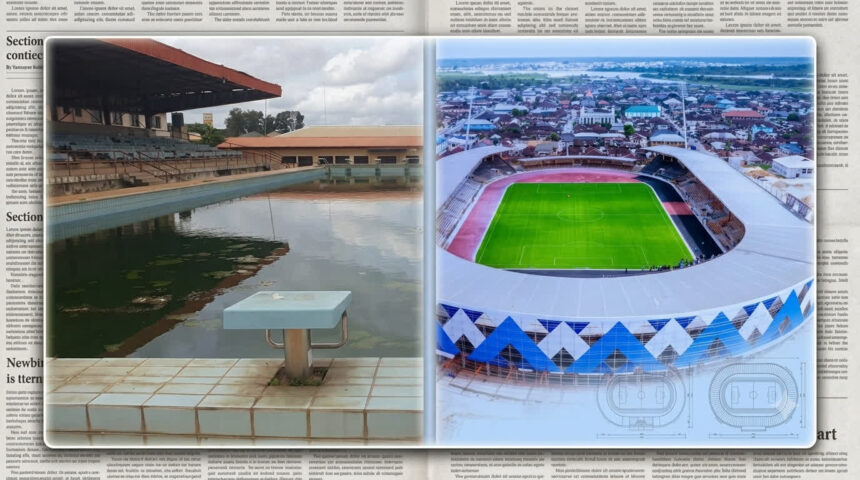
Ordering the immediate rehabilitation of the swimming pool facilities and perimeter gates at the Akure Sports Complex should ordinarily send waves of excitement across the Sunshine State.
Instead, it has triggered a collective sigh of frustration from a public exhausted by decades of cosmetic posturing.
Speaking on behalf of the Own Ondo Movement, I must ask the fundamental question echoing from Akure to the farthest corners of our land: for how much longer will Ondo State continue to settle for the skeletal status of an outdated sports complex built half a century ago, rather than stepping up to construct a modern, world-class stadium befitting our stature?
In an era where sports operates as a multi-billion-dollar global industry capable of tackling high youth unemployment, my team at the Own Ondo Movement notes with regret that our state remains trapped in an infinite loop of maintain-and-patch.
It is a historic embarrassment that a state blessed with vast natural wealth, abundant human potential, and a rich athletic legacy continues to recycle maintenance on a facility that no longer conforms with modern social infrastructure or global sporting standards.
A review by Prince Adeloye highlights how this systemic failure spans decades of successive leadership, beginning with the complex’s establishment under the military administration of the old Western region in 1976. Fifty years later, despite massive population growth, that original framework remains the state’s sole sporting hub.
Through the lens of the Own Ondo Movement, we recall that the late Governor Olusegun Agagu recognized this anomaly and awarded a contract for a brand-new stadium in the Maronu area of Akure, reaching roughly 30 percent completion before his tenure ended.
Unfortunately, Dr. Olusegun Mimiko’s administration completely abandoned the Maronu site, leaving it to overgrown weeds, and returned to patching the old facility, leaving administrative blocks, floodlights, and the swimming pool unfinished or neglected.
Subsequent leadership under the late Oluwarotimi Akeredolu and now Governor Lucky Aiyedatiwa has continued this lack of visionary leadership, where basic tasks like artificial pitch relaying and VIP stand retouches was celebrated, culminating in yet another routine repair campaign on the same pool and gates.
This visionary deficit becomes even starker when comparing Ondo State to neighboring states and regional peers that have actively overhauled their infrastructure. While Ondo continues to rely on a 50-year-old complex burdened by recurrent cosmetic repairs, declining medal counts, and sub-standard training grounds, other states are reaping massive rewards.
Akwa Ibom set the national benchmark with the world-class Godswill Akpabio International Stadium in Uyo, positioning itself as a prime hub for international football fixtures and corporate events. Edo State completely transformed the Samuel Ogbemudia Stadium in Benin City into a multi-sport, digitally equipped arena. Ogun State has demonstrated relentless initiative, not only through private-sector partnerships that birthed modern arenas like the Remo Stars Stadium in Ikenne, but also through the total renovation of the MKO Abiola Stadium in Abeokuta to drive grassroots sports development and capable of hosting CAF tournaments.
Furthermore, across the country, stadium reconstructions and upgrades have become the standard for forward-thinking governance. Kaduna Stadium is undergoing reconstruction to FIFA standards, while the Teslim Balogun Stadium in Lagos is being comprehensively redeveloped into an all-covered, modern arena. In the East, the Enugu State Government is executing a total renovation of the Nnamdi Azikiwe Stadium to host major national competitions, including the National Sports Festival.
Meanwhile, the new Warri City Stadium in Delta State is specifically designed to accommodate 17,000 to 20,000 spectators, equipped with a high-quality hybrid grass pitch, an advanced 9-lane track, modernized fiberglass roofing and cladding, and advanced surveillance systems. Among all other stadium renovations and reconstructions happening across Nigeria, Ondo State stands out as a glaring exception.
Meanwhile, Ondo State, a major oil-producing entity with vast revenue streams, claims fiscal constraints, proving that the true deficit is not financial, but visionary.
As Prince Adeloye, I firmly maintain that Ondo State remains an undisputed talent factory. On the football pitch, we have produced elite figures like Kenneth Omeruo, Godfrey Oboabona, Dayo Ojo, and Tunde Adeniji and host of others, who have earned the state significant prestige and foreign exchange through international transfers.
In track and field, Ondo State historically produced legendary sprinters like Seun Ogunkoya, once the fastest man in Africa and one of the youngest to break the 10-second barrier, alongside formidable track icons such as Lawrence Adegbehingbe, Taiwo Ajibade, and Yemi Ajibade.
These track stars represented Nigeria on global stages and plied their trade internationally, proving that our soil possesses an unparalleled athletics DNA.
Yet, despite generating immense glory through raw talent, the state refuses to build modern facilities, such as standard tartan tracks, to nurture the next generation.
A modern stadium complex is not an act of governmental charity; as we emphasize in the Own Ondo Movement, it is an economic driver that brings corporate sponsorships, hosts major non-sporting events, boosts local hospitality, and creates direct jobs for unemployed youths.
To truly unlock our potential, Prince Adeloye and the Own Ondo Movement propose a total departure from this piecemeal approach.
Ondo State should possess at least three standard stadiums strategically located across its Central, Northern, and Southern senatorial districts to catch and develop talent early, while also rehabilitating derelict sports grounds across all 18 local government areas.
Governor Lucky Aiyedatiwa’s administration must immediately wake up to modern reality, heed the call of the Forward Thinkers, abandon endless unrealistic maintenance campaigns on a 50-year-old complex, and build the modern sports infrastructure that the people of Ondo State rightfully deserve.