
By Ayobamiji Komolafe
Since the death of Minister Toluwanisings, I have struggled to put my thoughts into words. I have deliberately restrained myself from making any observations because his sudden death cuts too deep.
To lose a man in his prime, at just 34, is heartbreaking enough. But to know that we belong to the same age bracket makes the pain even more personal. What a promising future, abruptly interrupted! What a life that still had so much to give!

But why am I speaking now, even after he has been laid to rest?
Some have called out the interviewer for reopening wounds and giving oxygen to an issue they believe should have been allowed to rest. But I find myself looking beyond the interview. Beyond the controversy. Beyond the familiar arguments over who said what.
Have we paused to consider the silent battles this young man fought under the weight of being the ‘Olu Omo’, the glorious child, the family pride, the one upon whose shoulders everyone else’s expectations rested?
At just 34!
He reportedly sponsored relatives through education abroad. He had uncles coming to him to offset loans, buy tricycles and meet one financial demand or another. There were aunties to take care of, relatives to rescue and an endless list of people who apparently considered his success a family inheritance.
Some of the exchanges reportedly retrieved from his WhatsApp conversations with relatives are deeply disturbing. They reveal a dimension of his struggles that many may never have imagined.
At 34, while many of his contemporaries were still figuring out life, this young man was reportedly attending different therapy sessions, trying to preserve his sanity while still finding the strength to minister, inspire and bless other lives.
He could not even prioritise setting up his own wife because, apparently, there were extended family responsibilities that had to be settled first.
And what is particularly disturbing is the defence that followed. Some relatives reportedly dismissed those conversations as normal exchanges among siblings, insisting that nobody should attribute his death to family pressure.
But I ask again: What exactly is pressure? Must a person collapse under its weight before we acknowledge that it exists? Must someone die before we recognise that the demands we place on them may be suffocating?
Why is it that, sometimes, people outside a family seem to mourn the loss of a person more deeply than those who shared blood with them?
And now that he is gone, must his widow inherit the burden he could no longer carry? Must a woman already grieving the loss of her husband be subjected to another round of emotional and financial demands in the name of family settlement?
I have seen this pattern play out before. The so-called ‘Olu Omo’ dies, and the same people who made endless demands on him turn to his wife and children. The breadwinner is gone, but the appetite of the beneficiaries remains. The man who spent his lifetime meeting their needs is buried, yet his household is expected to continue financing the same demands that may have contributed to his struggles.
Where is the empathy? Where is our sense of responsibility? Where is the simple understanding that marriage creates a home, that children need security, and that a man’s immediate family should not be left to inherit the debts of everybody’s expectations?
Why have we become so heartless?
My conclusion is simple, albeit painful: Most Olu Omo no dey last. But the vultures who disguise themselves as family? They can outlive iroko trees in the deepest forests.
They will tell you not to let anybody kill you, yet they become the very people making survival difficult. They demand, guilt-trip, manipulate and, in some cases, resort to spiritual intimidation when their expectations are not met.
So, how exactly does one protect his life when the people demanding pieces of it are the very people he is expected to love, honour and protect?
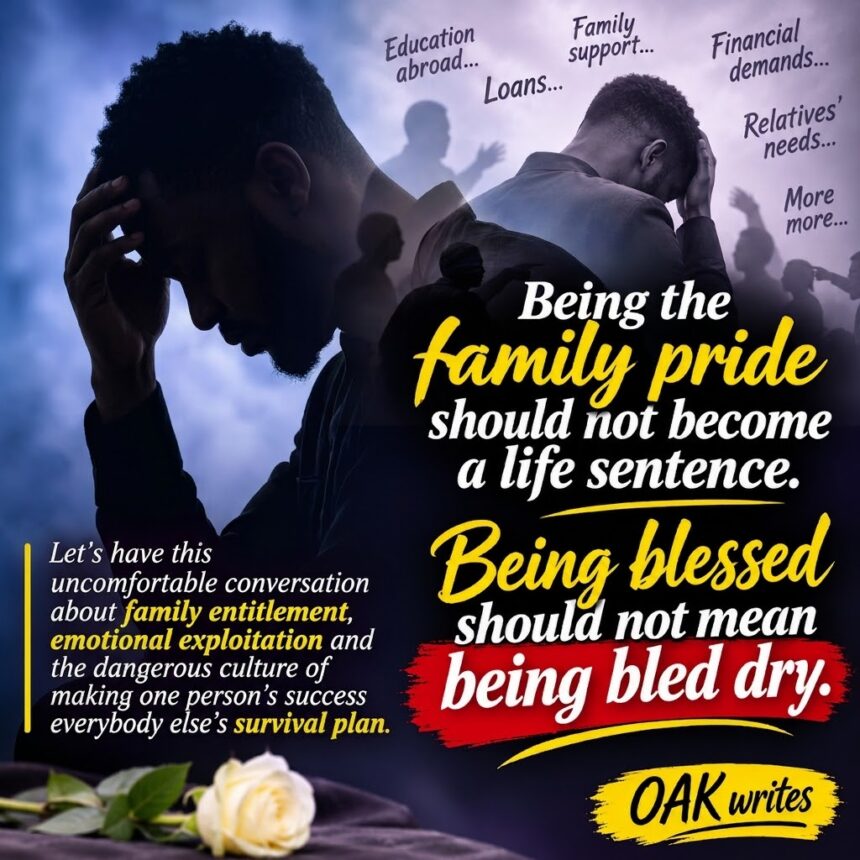
Perhaps we need to have this uncomfortable conversation about family entitlement, emotional exploitation and the dangerous culture of making one person’s success everybody else’s survival plan.
Being the family pride should not become a life sentence.
Being blessed should not mean being bled dry.
And being the ‘Olu Omo’ should not mean that you must sacrifice your peace, your marriage, your dreams and ultimately your life to prove that you love your family.
Sometimes, the greatest act of love is learning to say NO.
Because a man can be a blessing to his family and still deserve a life of his own.
May Toluwanisings’ death, at the very least, force us to confront the burdens we place on people simply because we believe they can carry them.
Not every burden is a blessing. Not every family demand is an obligation. And not every person who calls you family has your survival at heart.
OAK ✍️