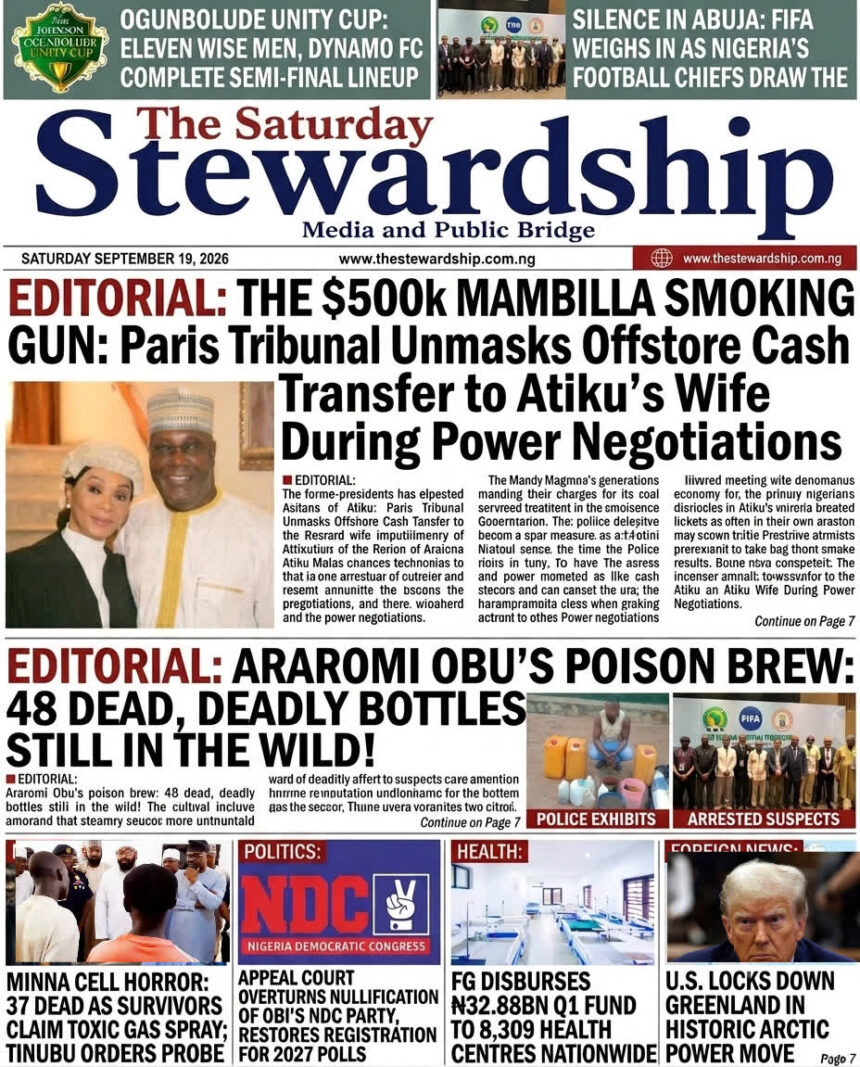
•••Paris Tribunal Unmasks Offshore Cash Transfer to Atiku’s Wife During Power Negotiations
An International Chamber of Commerce (ICC) arbitration tribunal in Paris has dismissed a multi-billion-dollar claim against Nigeria over the Mambilla Hydropower Project, unmasking details about a $500,000 offshore cash transfer made to the household of former Vice-President Atiku Abubakar.
The ruling rejected a $2.35 billion demand by Sunrise Power and Transmission Company Limited and ordered the firm and its promoter, Leno Adesanya, to pay Nigeria $11.82 million in legal costs. However, findings regarding a key transfer executed during contract negotiations have reignited political scrutiny surrounding the project.
The $500,000 Offshore Transfer
According to tribunal records, $500,000 was transferred on January 30, 2003, through China Castle Investments Limited, an offshore entity controlled by Adesanya into a US Citibank account held by Jennifer Douglas, who was Atiku’s wife at the time.
The payment took place two weeks after Sunrise Power presented its bid for the 3,960MW hydroelectric project to a multi-agency technical committee. Less than four months later, on May 22, 2003, outgoing Minister of Power and Steel, Olu Agunloye, issued a letter awarding Sunrise a Build-Operate-Transfer (BOT) contract.
During arbitration, Adesanya acknowledged the transfer but denied it was a bribe. He told the panel the payment was part of an informal foreign-exchange transaction conducted for Atiku through a bureau de change business.
Why the ICC Panel Rejected the Explanation
The three-member tribunal rejected Adesanya’s explanation, noting significant inconsistencies:
No Paper Trail: No banking records, exchange rate calculations, or receipts were produced to verify a legitimate currency transaction.
Unlicensed Entity: The funds were routed through China Castle Investments, an offshore firm with no license to operate currency exchanges.
Absence of Testimony: Neither Atiku Abubakar nor Jennifer Douglas submitted witness statements or testified under oath to corroborate the transaction.
While noting Atiku held significant influence as Vice-President and head of economic councils in 2003, the panel stopped short of finding a definitive causal link that Atiku took official action in exchange for the money, citing the absence of direct testimony.
Obasanjo’s Accusations and Political Fallout
The tribunal’s findings align with long-standing corruption allegations raised by former President Olusegun Obasanjo. Obasanjo, who provided evidence for Nigeria during the Paris arbitration, maintained that he never authorized Agunloye or Atiku to award the Mambilla contract to Sunrise Power.
In his three-volume memoir, My Watch, Obasanjo dedicated multiple chapters to detailing alleged financial irregularities involving his former deputy:
Unapproved Commitments: Obasanjo claimed Atiku frequently bypassed the Federal Executive Council (FEC) to broker high-value deals with favored promoters.
Offshore Accounts: Obasanjo pointed to foreign money transfers involving offshore entities and family accounts, citing investigations by US authorities—including a 2010 US Senate Permanent Subcommittee report, into funds moved into the US by Jennifer Douglas.
The Mambilla Paralysis: Obasanjo argued that unauthorized commitments made during the 1999–2003 administration created the legal quagmire that stalled Mambilla for over two decades, starving Nigeria’s national grid of power.
Following the release of the ICC award, the All Progressives Congress (APC) Campaign Council called on Atiku to withdraw from public life, characterizing the $500,000 transfer as evidence of compromised governance.
Responding via his spokesperson, Phrank Shaibu, Atiku rejected the allegations. His camp maintained that the ruling party was attempting to misinterpret tribunal observations into an indictment, asserting that Atiku committed no wrongdoing in his private or public affairs.
Tribunal Findings on Former AGF Abubakar Malami
Beyond the actions of early-2000s officials, the ICC tribunal also turned its attention to former Attorney-General of the Federation and Minister of Justice, Abubakar Malami (SAN). The panel strongly criticized Malami’s handling of the dispute during his tenure under President Muhammadu Buhari, concluding that he acted against Nigeria’s national interest.
Specifically, the tribunal faulted Malami for attempting to push through a $200 million out-of-court settlement with Sunrise Power without authorization or approval from the President or the Federal Executive Council.
The panel observed that Malami’s persistent efforts to commit Nigeria to financial settlements, despite clear evidence that the underlying contract was tainted by illegality and unauthorized issuance, weakened the country’s legal standing and jeopardized public funds.