
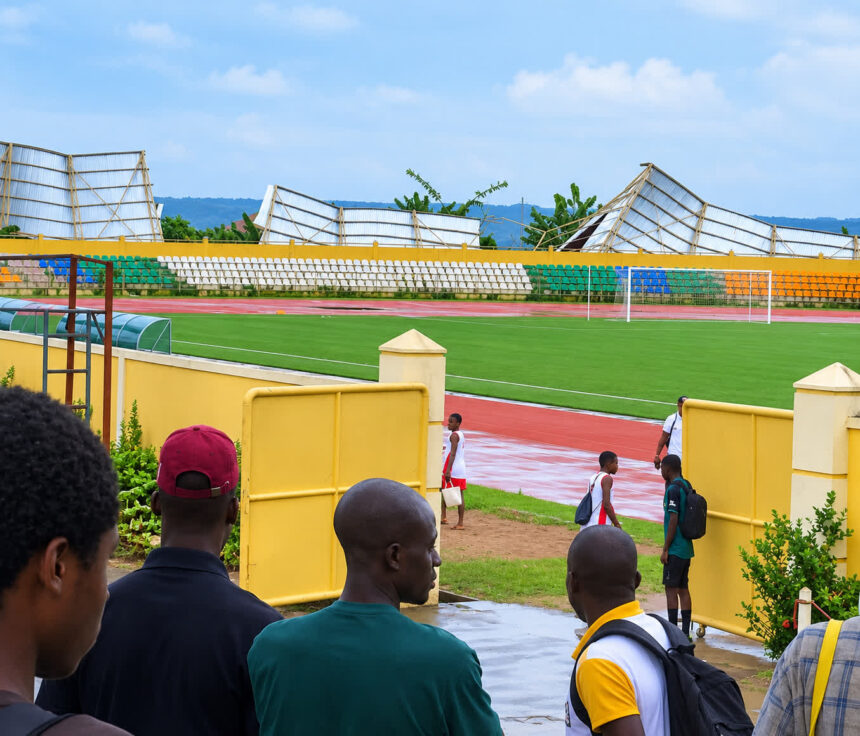
Serious concerns over public procurement standards, project supervision, and value for taxpayer money have emerged following a destructive windstorm that swept away the newly erected steel roof trusses and temporary support pillars at the ongoing Oluyemi Kayode Stadium renovation project in Ado-Ekiti.
The structural failure comes on the heels of massive state expenditure directed toward giving the facility a world-class facelift.
According to available public records, Governor Biodun Oyebanji’s administration approved ₦2.002 billion to kick-start the comprehensive overhaul of the main stadium, followed by a supplementary ₦1.06 billion for expanded works, including the pavilion canopy, an athletes’ hostel, and a multipurpose court. In addition, ₦7 billion was committed to constructing a brand-new, 900-seat indoor sports hall, bringing the total financial commitment across the complex to over ₦10.06 billion.
Despite these heavy financial disbursements, the physical execution on-site has raised red flags among engineering experts and concerned citizens alike. Prior to the storm incident, inspecting state government officials had already faulted and formally rejected several key components of the ongoing work, specifically pointing out defects in the newly laid athletics track, the sub-standard AstroTurf, and the weak steel roof trusses.
The structural vulnerability was laid bare when moderate wind currents easily collapsed the steel framework alongside flimsy two-by-two wooden supports propping up the roof.
Beyond the main arena, conditions at the indoor sports halls undergoing renovation have also been described as severely lagging and substandard, intensifying public outrage over how multi-billion-naira capital releases could result in such fragile, hazardous outcomes.
While government supporters argue that executive funding commitments demonstrate clear political goodwill toward sports development, critics and civil society groups maintain that releasing funds without rigorous site supervision creates a breeding ground for substandard construction.
Stakeholders are now demanding a full independent technical audit to investigate the supervising ministry, project consultants, and handling contractors, insisting that those responsible for compromising structural integrity must account for every naira spent and rectify the damage at no extra cost to the public treasury.